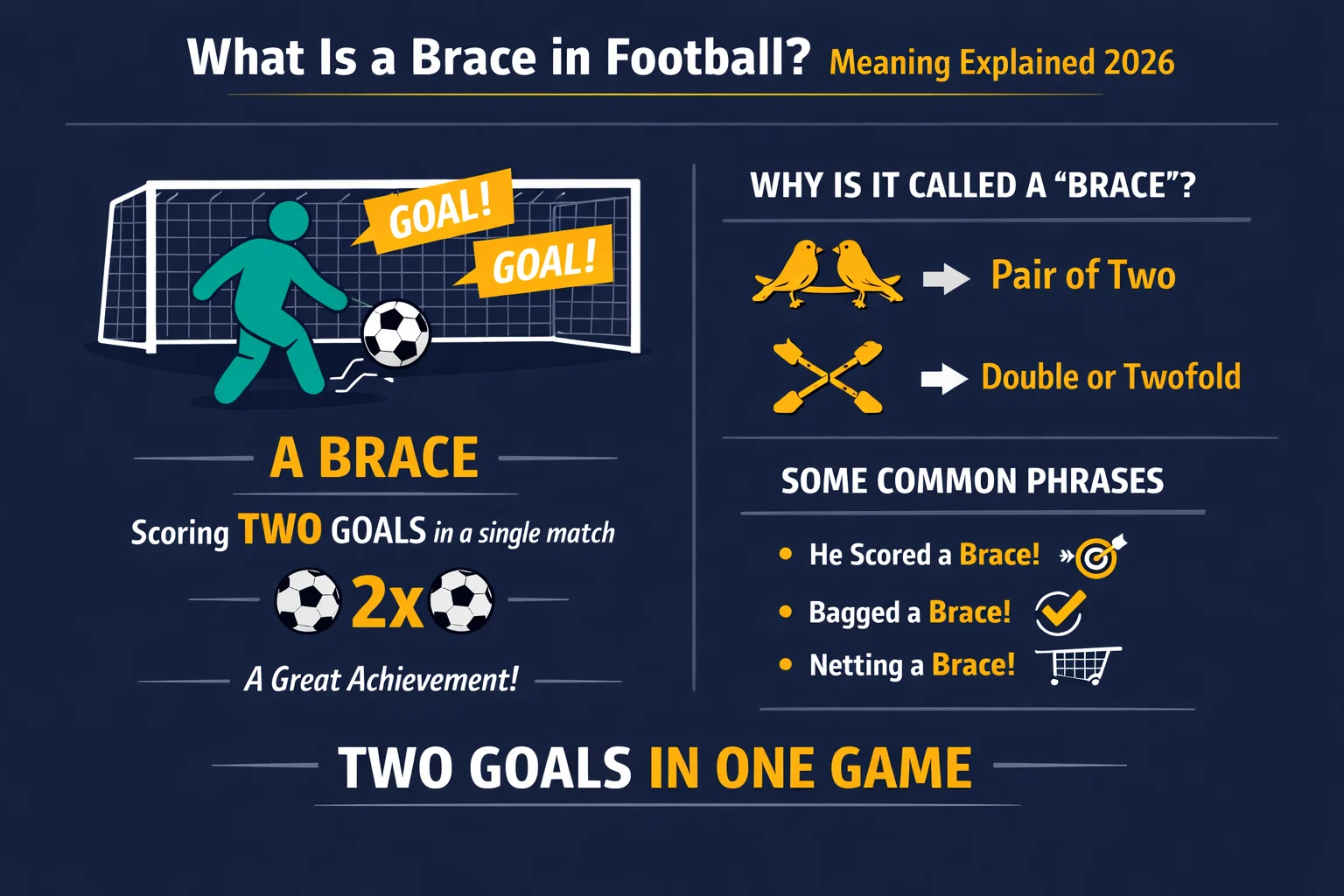
Quick Answer: A brace in football refers to a player scoring exactly two goals in a single match. It sits between a single goal and a hat-trick in football’s informal scoring terminology.
Turn on any football broadcast and you’ll hear commentators drop the term casually, almost as if everyone already knows exactly what it means: “He’s got himself a brace today.” For newer fans, it can sound oddly specific, like a piece of dental equipment rather than a football achievement, but the term is actually one of the sport’s most commonly used pieces of scoring shorthand, appearing in nearly every match report involving a two-goal performance.
This guide explains exactly what is a brace in football, where the term originally came from, how it compares to other scoring milestones, and some of the most memorable braces in the sport’s history.
What Does “Brace” Mean in Football?
A brace simply refers to two goals scored by the same player in a single match. There are no additional conditions attached to the term the two goals don’t need to be scored consecutively, in the same half, or without another player scoring in between. As long as one player finds the net twice in the same game, it’s accurately described as a brace, regardless of how the rest of the scoreline develops or which team ultimately wins the match.
Where Does the Term “Brace” Come From?
The word “brace” has origins that predate football entirely, historically used in English to describe a pair of something, most commonly associated with hunting terminology referring to a pair of game birds, such as “a brace of pheasants.” Over time, this usage extended into general English vocabulary to describe any pair of matching items, and football commentators and journalists eventually adopted the term as convenient shorthand for a player’s two-goal performance, likely borrowing the same “pair” concept used across other British sporting and hunting traditions that were already well established in the language.
Brace vs. Hat-Trick vs. Other Scoring Terms
Football has developed a small vocabulary of informal terms to describe multi-goal performances by a single player across a match:
- A brace refers to exactly two goals scored by one player in a match.
- A hat-trick refers to exactly three goals scored by one player in a match.
- A perfect hat-trick refers to three goals scored using three different methods typically one with the right foot, one with the left foot, and one with the head.
- Beyond three goals, terms become less standardized, though four goals is sometimes informally referred to as a “haul” rather than having a single widely accepted specific term.
Brace vs. Hat-Trick: Quick Comparison
| Term | Number of Goals | Special Conditions |
|---|---|---|
| Brace | 2 | None |
| Hat-trick | 3 | None (goals can be spread across the match) |
| Perfect hat-trick | 3 | Must include a right-foot, left-foot, and headed goal |
Does a Brace Count Toward a Player’s Season Statistics?
Yes, both goals in a brace count fully toward a player’s season goal tally, just as they would if scored in separate matches on different weekends. The term “brace” itself is purely descriptive shorthand used in commentary, match reports, and statistics summaries, rather than an official scoring category recognized separately by football’s governing bodies. It simply gives fans and journalists a quicker, more natural way to describe a two-goal performance without repeating the phrase “scored twice” throughout an article or broadcast, improving readability and flow in match coverage.
Notable Braces in Football History
Braces occur far more frequently than hat-tricks, given the lower goal threshold, but certain two-goal performances have still become memorable due to their context or significance within a specific competition. Multiple braces have decided major cup finals and title-deciding matches over the decades, with a player’s two goals often proving to be the exact margin of victory in tightly contested fixtures where every chance created and finished carries substantial weight on the final outcome.
International tournaments regularly feature braces from star forwards in knockout stages, often turning a player into a decisive figure for their national team’s run through a competition, with these performances frequently referenced for years afterward as turning points in a nation’s tournament history.
Braces are particularly common from strikers who also occasionally record hat-tricks, since players clinical enough to regularly score twice in a match are statistically also the most likely candidates to eventually complete a hat-trick when circumstances and opportunities align favorably during a single game.
Why Understanding Scoring Terms Matters for New Fans
Learning football’s informal scoring vocabulary, including terms like brace and hat-trick, makes it significantly easier to follow match reports, post-game analysis, and statistics summaries without constantly needing clarification or a quick internet search mid-broadcast. These terms appear extremely frequently in football media, from live commentary to social media reactions, and missing their meaning can make otherwise straightforward football coverage feel confusing to newer fans still building familiarity with the sport’s broader terminology and culture.
Players Known for Frequently Scoring Braces
Certain elite strikers have built reputations partly around their consistency at scoring multiple goals in a single match, making braces a regular occurrence rather than a rare highlight throughout an entire season. Players like Erling Haaland, Robert Lewandowski, and Harry Kane have all recorded exceptionally high numbers of braces across their careers, reflecting not just raw goal-scoring ability but also the tactical systems built around them to consistently create high-quality chances throughout a match rather than just isolated moments. Analysts often use brace frequency, alongside hat-trick counts, as one of several statistical indicators when comparing elite strikers’ overall clinical finishing and consistency across a full competitive season.
How the Term “Brace” Is Used in Football Media
Beyond live commentary, the term appears constantly across written football journalism, social media reactions, and statistical databases tracking player performance across an entire season. Headlines frequently use “brace” as a space-efficient way to summarize a match result, such as “Player X scores brace in derby win,” allowing publications to convey a meaningful individual performance without lengthy explanation. This widespread media usage is part of why understanding the term quickly becomes essential for anyone following football coverage regularly, since it appears across nearly every major football publication, broadcast, and fan community discussion online.
Do Other Sports Use Similar Multi-Scoring Terminology?
Football isn’t the only sport with informal terminology to describe multiple scoring feats by a single player during a single contest. Ice hockey uses “hat-trick” in essentially the same way football does, for three goals in a single game, a usage that actually predates football’s own adoption of the term by several decades. Cricket’s own hat-trick, referring to three wickets on consecutive deliveries, is where the phrase originated before spreading to other sports entirely. However, “brace” is far more specifically associated with football and shooting sports compared to other major team sports, which typically don’t have an equivalent widely used two-goal or two-point specific term in the same conversational way fans and commentators use it.
Why Two Goals Can Be Just as Impactful as Three
While a hat-trick often draws more headlines due to its relative rarity, a brace can be equally, if not more, significant depending on match context and the stakes involved. A player scoring twice in a tight 2-1 victory has effectively decided the entire outcome of the match, arguably carrying more tactical weight than a hat-trick scored in an already one-sided 5-0 win. This is part of why football analysts increasingly emphasize context alongside raw goal counts when evaluating a player’s individual performance, rather than treating terms like brace and hat-trick as automatic, standalone indicators of match impact without considering the surrounding circumstances.
Why Braces Matter in Fantasy Football
Beyond match reports and commentary, the concept of a brace carries direct practical relevance for fantasy football players and betting markets. Most fantasy football scoring systems award bonus points for multiple goals scored by the same player in a single gameweek, meaning a brace can significantly boost a fantasy manager’s score compared to two separate single-goal performances spread across different weeks. Similarly, “anytime brace” or “player to score 2 or more” markets are common betting options at bookmakers, reflecting how widely recognized and statistically trackable the concept has become across football’s broader ecosystem of media, fantasy games, and wagering markets.
Frequently Asked Questions
What is a brace in football? A brace refers to a player scoring exactly two goals in a single match, with no additional conditions attached to the term.
Does a brace need to be two consecutive goals? No, the two goals can occur at any point during the match, in either half, regardless of whether other players score in between.
What is the difference between a brace and a hat-trick? A brace refers to two goals scored by one player in a match, while a hat-trick refers to three goals scored by one player in the same match.
Where does the word “brace” come from? The term originates from historical English hunting vocabulary, referring to a pair of game birds, and was later adopted into football as shorthand for a two-goal performance.
Is a brace an official football statistic? No, “brace” is informal terminology used in commentary and journalism rather than an official statistical category recognized by football’s governing bodies.
Is scoring a brace considered a significant achievement? While less rare than a hat-trick, a brace is still considered a strong individual performance, particularly in tightly contested or high-stakes matches where two goals can decide the entire result.
Do other sports use the term “brace”? The term is most closely associated with football and traditional hunting terminology, while other sports like ice hockey use their own equivalent terms, such as “hat-trick,” for multi-scoring feats.
Who holds the record for the most career braces in football? Records vary by competition and are tracked differently across leagues, though elite modern strikers like Lionel Messi, Cristiano Ronaldo, and Robert Lewandowski rank among the most frequent brace-scorers in top-flight football history.
Does a brace affect fantasy football scoring? Yes, most fantasy football platforms award bonus points for multiple goals scored by the same player in a single match, making a brace notably more valuable than two separate single-goal performances.
Is there an official minimum time frame for a brace? No, unlike some stricter historical definitions of a hat-trick, a brace has never required any specific timing between the two goals, whether scored minutes apart or across both halves of a match.
Conclusion
So, what is a brace in football? At its simplest, it’s just football’s way of describing two goals from the same player in a single match a small but genuinely useful piece of terminology that appears constantly across commentary, match reports, and fan discussion, and one that can carry just as much tactical significance as a hat-trick depending on the context of the match.
Understanding terms like this makes following the sport’s coverage far smoother, especially as you build toward recognizing bigger milestones like a hat-trick. Want to learn about the next level up? Check out our guide on What is a Hat-Trick in Football for the complete breakdown of that milestone and its most famous examples.

Emily Parker is a sports journalist at SportsOrbitX.com with a passion for covering cricket, tennis and major international sporting events. She is committed to producing clear, reliable and engaging content for sports enthusiasts worldwide.