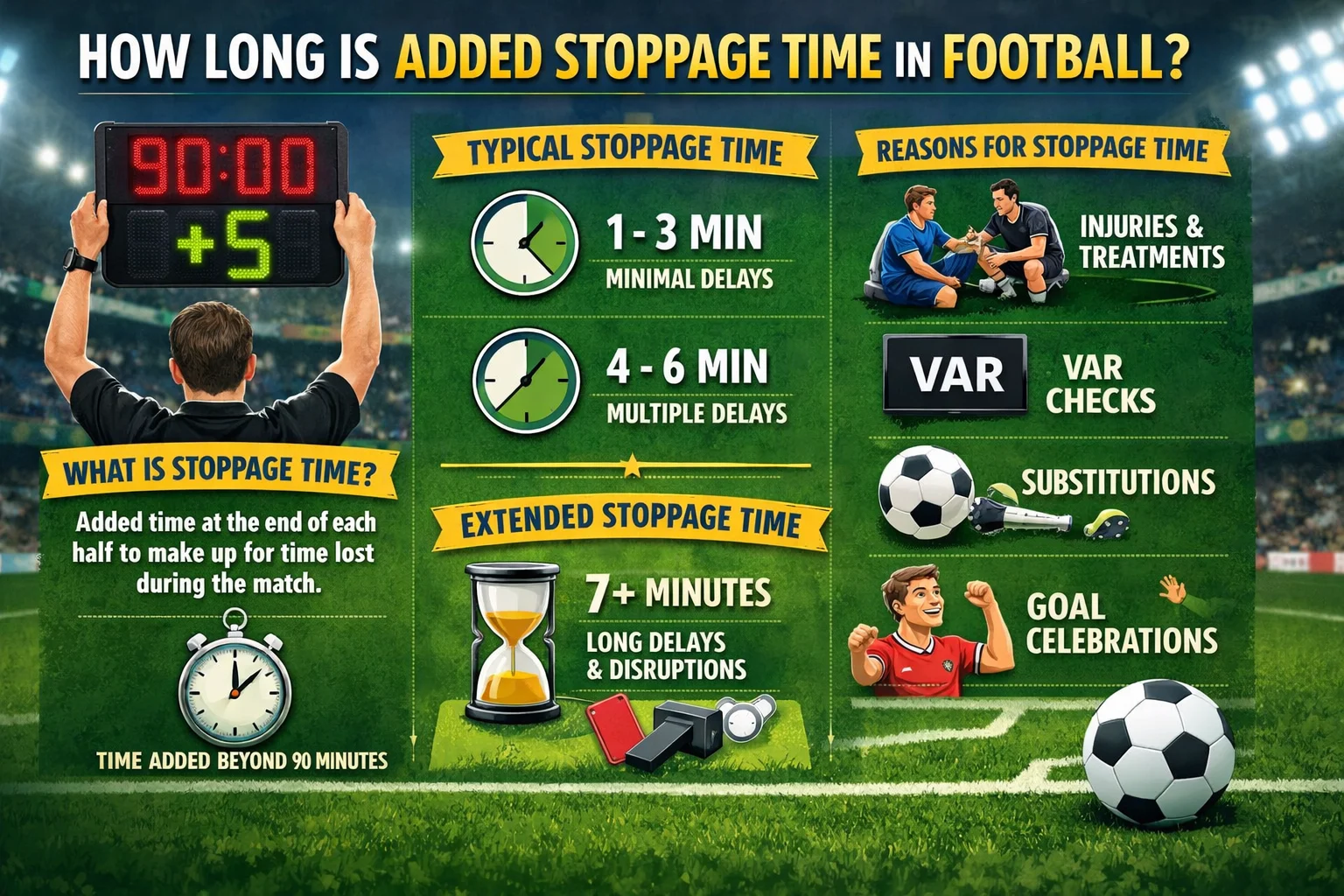
Quick Answer: Added stoppage time in football typically ranges from 1 to 6 minutes per half under traditional calculations, though recent rule interpretations at major tournaments have pushed this figure considerably higher, sometimes exceeding 10 minutes, to more accurately account for time genuinely lost during a match rather than a rough, informal estimate.
The 90-minute mark ticks by, but the match doesn’t stop. Instead, a fourth official raises an electronic board showing a number that always seems to catch fans off guard sometimes just 2 or 3 minutes, other times a startling 8, 9, or even 10 or more. For newer fans, this extra period can feel like an arbitrary decision made on the spot, but it actually follows a fairly specific calculation method that has become significantly more precise in recent years, especially since major tournaments began overhauling how the process works.
This guide explains how long is added stoppage time in football, exactly how referees calculate it, and why recent tournaments have seen noticeably longer additions than in previous decades of the sport’s history.
What Is Stoppage Time?
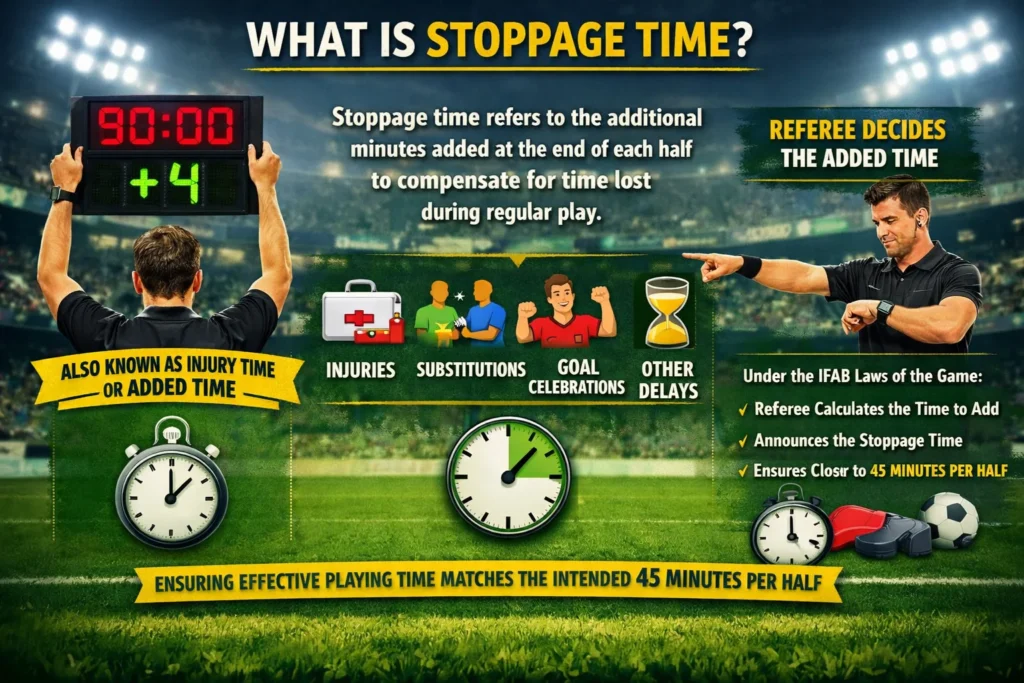
Stoppage time, also known as injury time or added time, refers to the additional minutes played at the end of each half to compensate for time lost during regular play due to stoppages like injuries, substitutions, goal celebrations, and other delays. Under the IFAB Laws of the Game, the referee is solely responsible for calculating and announcing this time, ensuring that the effective playing time of a match comes closer to the intended 45 minutes per half, rather than falling meaningfully short due to accumulated stoppages throughout the game.
How Referees Calculate Stoppage Time
The fourth official tracks specific delays throughout each half using a stopwatch dedicated solely to this purpose, and the referee uses this information to determine the appropriate amount of added time at the end of the period. Common factors that contribute to stoppage time include:
- Time lost to player injuries and on-field medical treatment
- Time taken for substitutions to be completed
- Excessive goal celebrations, particularly after a late equalizer or winner
- Time-wasting tactics, such as slow ball retrieval or deliberate delays
- VAR reviews, which can add several minutes depending on the complexity of the check
- Any other significant stoppage, such as crowd trouble or facility issues
Referees are trained to track these delays continuously rather than estimating them at the end of the half, which is part of why recent stoppage time additions have become noticeably more accurate and, in many cases, longer than in previous eras.
Why Has Stoppage Time Increased in Recent Years?
Football’s approach to calculating stoppage time shifted significantly starting around the 2022 FIFA World Cup in Qatar, where referees began adding considerably more time than fans had grown accustomed to, in some matches exceeding 10 minutes per half. This change was driven by a deliberate push from IFAB and FIFA to more precisely account for actual time lost, rather than relying on a rougher estimate that often fell short of the true amount of dead time during a match. This stricter approach has continued into subsequent tournaments, including the 2026 FIFA World Cup, where fans and pundits have grown more accustomed to seeing longer stoppage time additions as the new standard rather than an unusual exception, fundamentally reshaping expectations around how a match’s true playing time is measured.
Typical Stoppage Time by Situation
| Situation | Typical Added Time |
|---|---|
| Standard half with few stoppages | 1–3 minutes |
| Half with one or two substitutions | 3–5 minutes |
| Half with a significant injury stoppage | 5–7 minutes |
| Half with VAR review(s) | Additional 2–5 minutes on top of other factors |
| Major tournament matches (post-2022 standard) | Often 6–10+ minutes |
Does Stoppage Time Differ Between Competitions?
Yes, while the underlying IFAB Laws of the Game apply universally across all levels of the sport, individual competitions and even individual referees can interpret the calculation with slightly different levels of strictness. Major international tournaments like the FIFA World Cup have generally adopted longer, more precisely calculated stoppage time since 2022, while some domestic leagues have been slower to adjust their overall approach, resulting in noticeable differences in average added time between, for example, a Premier League match and a World Cup knockout fixture played in the same calendar year.
Can Additional Stoppage Time Be Added During Stoppage Time Itself?
Yes, this is a common point of confusion for newer fans watching a tense final few minutes of a match. If a significant stoppage occurs during the announced stoppage time itself, such as an injury or a VAR review, the referee can extend play even further beyond the originally displayed number. The board held up by the fourth official represents a minimum estimate at that point in the match, not a strict, unchangeable cutoff that guarantees the game ends the moment that time expires.
A Brief History of Stoppage Time in Football
The concept of adding time to compensate for stoppages has existed since football’s early formalized rules, though the specific calculation method has evolved considerably. For most of the 20th century, referees relied on a fairly informal, subjective estimate, often resulting in additions of just 1 or 2 minutes regardless of how many delays actually occurred during a half. This looser approach persisted for decades, contributing to a widely held perception among fans that stoppage time was somewhat arbitrary or even occasionally used to influence a specific result. The shift toward stricter, more transparent calculation began gaining momentum in the early 2020s, culminating in the notably longer additions seen throughout the 2022 FIFA World Cup, which fundamentally reset fan expectations for how stoppage time should be calculated going forward.
Notable Stoppage Time Moments in Football History
Certain matches have become memorable specifically because of dramatic moments occurring deep into stoppage time:
- Manchester United’s famous 1999 Champions League final comeback against Bayern Munich included two goals scored in stoppage time, an moment still frequently referenced as one of the most dramatic conclusions in the competition’s history.
- Several matches at the 2022 and 2026 FIFA World Cups have featured decisive goals scored well past the 10-minute mark of stoppage time, a direct reflection of the tournament’s stricter added-time calculations compared to previous decades.
- Domestic league title races have occasionally been decided by stoppage time goals, with these moments often becoming iconic reference points in a club’s history long after the match itself has been forgotten by casual fans.
How Longer Stoppage Time Has Affected Team Strategy
The shift toward longer, more precisely calculated stoppage time has meaningfully influenced how coaches approach the closing stages of a match. Teams protecting a lead can no longer assume that reaching the 90-minute mark with a narrow advantage guarantees safety, since an extra 8 or 10 minutes provides considerably more opportunity for an equalizer or late winner than the shorter additions of previous decades. This has led some coaches to adjust their substitution timing, bringing on fresh legs slightly earlier to ensure players have the stamina to maintain defensive intensity through a potentially lengthy stoppage period. Conversely, teams chasing a result have found renewed hope in these longer additions, with several high-profile matches at recent tournaments decided by goals scored well past the 90th minute, a scenario that was considerably rarer under the older, shorter stoppage time norms.
How Broadcasters and Fans Have Adapted to Longer Stoppage Time
The shift toward longer, more accurately calculated stoppage time has required some adjustment from broadcasters, who now build additional buffer time into match-day television schedules to avoid cutting away from a game before its natural conclusion. Fans, similarly, have had to recalibrate their expectations, with many now treating the 90-minute mark as a rough guideline rather than a near-certain endpoint, particularly during high-stakes matches with multiple substitutions, injuries, or VAR interventions likely to extend the added time considerably beyond older norms.
Is Stoppage Time the Same as Extra Time?
It’s worth clarifying a common point of confusion between two related but distinct concepts. Stoppage time refers to the additional minutes added within a standard 90-minute match to compensate for delays, while extra time refers to two separate additional periods, typically 15 minutes each, played in knockout competitions when a match remains level after the standard 90 minutes plus stoppage time have been completed. Extra time itself also includes its own stoppage time additions at the end of each 15-minute period, meaning a tense knockout match can genuinely extend well beyond two full hours of total playing time once every addition is accounted for.
Frequently Asked Questions
How long is added stoppage time in football on average? Stoppage time traditionally ranged from 1 to 6 minutes per half, though major tournaments since 2022 have regularly seen additions of 6 to 10 minutes or more.
Who decides how much stoppage time is added? The main referee makes the final decision on stoppage time, using information tracked by the fourth official throughout the half.
Why was stoppage time so much longer at recent World Cups? FIFA and IFAB pushed for stricter, more accurate stoppage time calculations starting at the 2022 World Cup, accounting more precisely for time lost to celebrations, substitutions, and VAR reviews.
Can a match go on longer than the displayed stoppage time? Yes, if a new stoppage occurs during the announced added time, the referee can extend the match further beyond the originally displayed number.
Does stoppage time count toward a player’s total minutes played? Yes, any time played during stoppage time counts toward a player’s official minutes played in a match.
Is stoppage time the same as extra time? No, stoppage time refers to added minutes within a normal 90-minute match, while extra time refers to two additional 15-minute periods played in knockout matches that remain tied after 90 minutes.
Why do goal celebrations add to stoppage time? Referees account for the time players spend celebrating a goal, since this delay takes away from the effective playing time of the match, particularly with modern, often lengthy celebrations involving several players and coaching staff.
Has stoppage time calculation changed at the 2026 World Cup? Yes, the 2026 tournament has continued the stricter calculation approach first introduced in 2022, with fourth officials tracking delays throughout each half to produce longer, more precise added-time figures compared to pre-2022 norms.
Do lower-division and amateur matches follow the same stoppage time rules? In principle, yes, since the IFAB Laws of the Game apply universally, though in practice, lower-level matches often rely on less rigorous tracking, resulting in shorter and less precisely calculated additions than top-tier professional competitions.
Conclusion
So, how long is added stoppage time in football? While the traditional range was a modest 1 to 6 minutes, recent years have seen this figure grow substantially, particularly at major tournaments where referees now track delays with far greater precision, a trend that has continued through the 2026 World Cup. Understanding what causes stoppage time, and why it has become longer since 2022, makes those tense final minutes of a match much easier to follow, rather than feeling like an unpredictable mystery every time the fourth official raises the board.
Want to understand more of the officiating side of football? Check out our guide on What Does VAR Stand For in Football to see how video reviews factor directly into these added-time calculations.

Daniel Brooks is a sports writer at SportsOrbitX.com, specializing in football, basketball and global sports news. He focuses on delivering accurate reporting, match analysis and timely updates that keep fans informed.