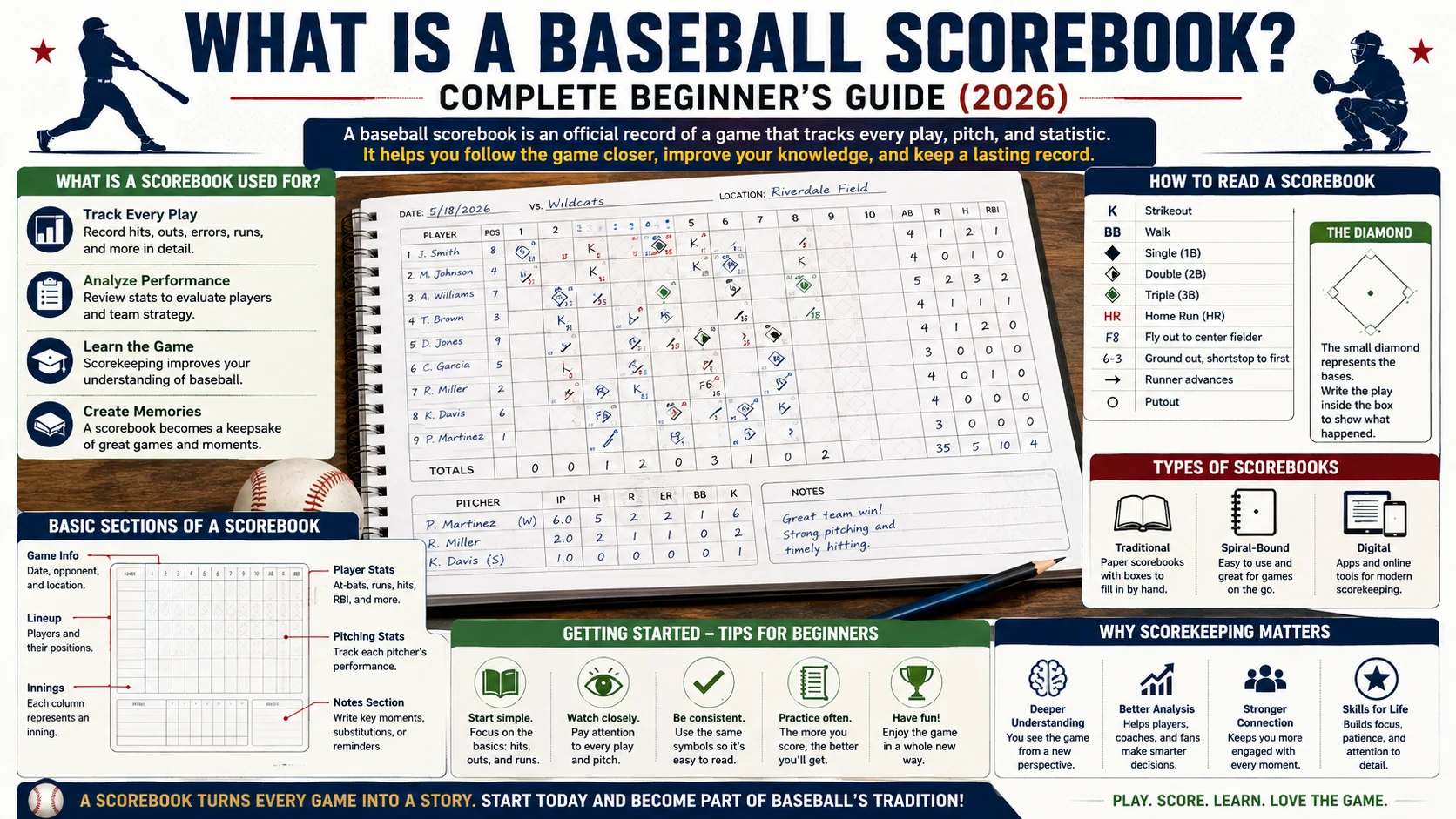
A baseball scorebook is a scoring system that records every pitcher’s and player’s actions throughout a game. Each batter receives a box where scorekeepers document hits, outs, walks, strikeouts, runs, RBIs, and defensive plays using standardized baseball scoring symbols.
A baseball scorebook is a notebook or printed scorecard used to record every play during a baseball game. It helps coaches, players, scorekeepers, and fans track runs, hits, outs, errors, pitching changes, and player statistics inning by inning. Whether you’re keeping score for a youth league or a professional game, a scorebook provides a permanent record of what happened on the field.
Baseball Scorebook at a Glance
| Feature | Description |
|---|---|
| Purpose | Record every play during a baseball game |
| Used By | Coaches, scorekeepers, parents, players, scouts, and fans |
| Tracks | Hits, runs, outs, errors, substitutions, pitching stats, innings |
| Format | Printed notebook, scorecard, or digital app |
| Skill Level | Beginner to professional |
| Main Benefit | Creates an official game record and player statistics |
What Is a Baseball Scorebook?
A baseball scorebook is much more than a notebook filled with numbers. It is the official written record of a baseball game, documenting every important event from the first pitch to the final out.
Unlike many sports where fans simply watch the action, baseball has a long tradition of scorekeeping. Every at-bat, defensive play, pitching change, stolen base, and run can be recorded in a scorebook using a universal scoring system that has been used for generations.
Each player in the batting lineup has a dedicated row, while every inning contains a scoring box where the scorekeeper records the outcome of each plate appearance.
By the end of the game, the scorebook tells the complete story of how the game unfolded.
Why Is a Baseball Scorebook Important?
Many new fans assume scorebooks are only for official scorekeepers. In reality, they provide value for nearly everyone involved in the game.
A well-maintained scorebook helps:
- Record every play accurately.
- Track player performance.
- Verify official statistics.
- Analyze offensive and defensive trends.
- Review pitching performance.
- Settle scoring disputes.
- Preserve memorable games for future reference.
For coaches, scorebooks are valuable evaluation tools. For parents, they become lasting keepsakes of a child’s baseball journey. For dedicated fans, keeping score adds another level of enjoyment and engagement during every inning.
What Information Does a Baseball Scorebook Record?
A standard baseball scorebook captures nearly every detail of a game.
Common information includes:
Game Details
- Date
- Time
- Location
- Teams
- Weather conditions
- League or tournament name
- Umpires
Team Lineups
Before the first pitch, scorekeepers record:
- Player names
- Jersey numbers
- Batting order
- Defensive positions
Offensive Statistics
Each batter’s performance can include:
- Singles
- Doubles
- Triples
- Home runs
- Walks
- Strikeouts
- Hit by pitch
- Sacrifice flies
- Sacrifice bunts
- Runs scored
- RBIs
- Stolen bases
Defensive Plays
Scorebooks also document:
- Putouts
- Assists
- Errors
- Double plays
- Triple plays
- Fielding choices
Pitching Statistics
Many scorebooks include sections for:
- Innings pitched
- Strikeouts
- Walks allowed
- Hits allowed
- Runs
- Earned runs
- Pitch count
How Does a Baseball Scorebook Work?
A baseball scorebook follows a simple but organized layout.
Each batter receives a row across the page.
Each inning has its own scoring box.
When a player comes to bat, the scorekeeper records exactly what happens inside that box using baseball scoring symbols.
For example:
- Strikeout
- Walk
- Groundout
- Single
- Double
- Home run
As runners advance around the bases, the scorekeeper draws lines inside the diamond printed within each scoring square.
When a runner scores, the diamond is completed or shaded to indicate a run.
Over nine innings or fewer in youth baseball the scorebook gradually becomes a complete visual history of the game.
Parts of a Baseball Scorebook
Although designs vary between manufacturers, most scorebooks contain the same core sections.
Team Information
Usually found at the top of each page.
Includes:
- Team names
- Opponent
- Date
- Field
- Weather
- Game number
Batting Order
Every player receives a dedicated line.
Typical columns include:
- Player name
- Jersey number
- Position
- At-bats for each inning
Scoring Boxes
Each inning contains one scoring box for every batter.
Inside each box, scorekeepers record:
- Hits
- Outs
- Walks
- Strikeouts
- Runs
- RBIs
- Base advancement
These boxes form the heart of the scorebook.
Pitching Section
Many scorebooks dedicate separate pages or columns to pitchers.
Common statistics include:
| Statistic | Meaning |
|---|---|
| IP | Innings Pitched |
| H | Hits Allowed |
| R | Runs Allowed |
| ER | Earned Runs |
| BB | Walks |
| SO | Strikeouts |
| PC | Pitch Count |
Team Totals
At the end of each game, the scorekeeper summarizes:
- Runs
- Hits
- Errors
- Left on Base (LOB)
- Winning pitcher
- Losing pitcher
- Time of game
Baseball Scorebook Symbols Explained
One reason scorekeeping seems difficult is the use of abbreviations.
Fortunately, most baseball symbols are straightforward once you learn them.
| Symbol | Meaning |
|---|---|
| 1B | Single |
| 2B | Double |
| 3B | Triple |
| HR | Home Run |
| BB | Base on Balls (Walk) |
| SO or K | Strikeout |
| HBP | Hit by Pitch |
| FC | Fielder’s Choice |
| E | Error |
| SB | Stolen Base |
| CS | Caught Stealing |
| SAC | Sacrifice |
| DP | Double Play |
| TP | Triple Play |
After just a few innings, most beginners become comfortable recognizing these abbreviations.
Baseball Position Numbers Every Scorekeeper Should Know
Instead of writing player names on every defensive play, scorekeepers use position numbers.
These numbers are universal across all levels of baseball.
| Number | Position |
|---|---|
| 1 | Pitcher |
| 2 | Catcher |
| 3 | First Baseman |
| 4 | Second Baseman |
| 5 | Third Baseman |
| 6 | Shortstop |
| 7 | Left Fielder |
| 8 | Center Fielder |
| 9 | Right Fielder |
For example:
6–3
means the shortstop (6) fielded the ball and threw it to the first baseman (3) for the out.
Likewise:
4–6–3
represents a classic double play involving the second baseman, shortstop, and first baseman.
Learning these numbers is one of the biggest steps toward understanding a baseball scorebook.
Beginner Example: Recording One Plate Appearance
Imagine the leadoff hitter steps to the plate.
Here’s what happens:
- The batter hits a ground ball to the shortstop.
- The shortstop throws to first base.
- The batter is out.
The scorekeeper records:
6–3
This simple notation instantly tells anyone reading the scorebook exactly how the out occurred without writing a full sentence.
As the game progresses, these symbols combine to create a complete play-by-play record that experienced scorekeepers can read almost like a language.
How to Keep Score in a Baseball Scorebook
Once you understand the layout and symbols, keeping score becomes much easier. The goal isn’t to write long notes—it’s to record each play using standardized baseball notation.
A typical scoring sequence follows these steps:
Step 1: Record the Batter
Find the player’s row in the batting order and the current inning’s scoring box.
Every plate appearance starts in this box.
Step 2: Record the Result
Write the outcome using baseball scoring symbols.
Examples include:
| Play | Scorebook Notation |
|---|---|
| Single | 1B |
| Double | 2B |
| Triple | 3B |
| Home Run | HR |
| Walk | BB |
| Strikeout | K or SO |
| Hit by Pitch | HBP |
| Groundout Shortstop to First | 6–3 |
| Fly Out to Center Field | F8 |
Step 3: Mark Runner Advancement
Each scoring box contains a small baseball diamond.
As runners advance:
- Draw a line to first base.
- Continue to second if they advance.
- Extend the line to third when appropriate.
- Complete the diamond when the runner scores.
Many scorekeepers shade or color the completed diamond to make runs easy to identify at a glance.
Step 4: Record RBIs and Runs
If the batter drives in runs:
- Add the RBI total.
- Complete the base path for runners who score.
- Record the run in the team totals.
This creates a complete visual history of every scoring play.
Example of a Scored Inning
Imagine the following sequence:
- Batter A hits a single.
- Batter B draws a walk.
- Batter C hits a double.
- Two runners score.
- Batter D strikes out.
- Batter E grounds out.
- Batter F flies out.
The scorebook would show:
- 1B
- BB
- 2B (2 RBI)
- K
- 4–3
- F8
By reading only these symbols, an experienced scorekeeper can recreate the entire inning.
How to Score Common Baseball Plays
Single
Write:
1B
Draw the runner to first base.
Double
Write:
2B
Advance the runner to second.
Triple
Write:
3B
Advance the runner to third.
Home Run
Write:
HR
Complete the diamond to indicate a run scored.
Record any additional runners who cross home plate.
Walk
Write:
BB
Advance the batter to first.
Move forced runners if necessary.
Strikeout
Write:
K or SO
The scoring box ends because the batter is out.
Hit by Pitch
Write:
HBP
Advance the batter to first base.
Error
Write:
E followed by the player’s defensive position.
Example:
E5
This means the third baseman committed an error.
Fielder’s Choice
Record:
FC
The batter reaches safely while another runner is retired.
Stolen Base
Write:
SB
Advance the runner to the next base.
Caught Stealing
Write:
CS
The runner is thrown out attempting to steal.
Double Play
A double play is recorded using defensive position numbers.
Example:
6–4–3 DP
Meaning:
- Shortstop fields the ball.
- Throws to second baseman.
- Second baseman throws to first.
- Two outs recorded.
How to Record Pitching Changes
Most scorebooks include a dedicated pitching section.
Whenever a new pitcher enters the game, record:
- Pitcher’s name
- Inning entered
- Outs inherited (if applicable)
- Pitch count (optional)
- Strikeouts
- Walks
- Runs allowed
- Earned runs
This information helps coaches evaluate pitching performance throughout the season.
Paper vs. Digital Baseball Scorebooks
Today’s scorekeepers can choose between traditional paper scorebooks and digital scoring apps.
Both options have unique advantages.
| Feature | Paper Scorebook | Digital Scorebook |
|---|---|---|
| Battery Required | No | Yes |
| Easy to Learn | Yes | Moderate |
| Automatic Statistics | No | Yes |
| Historical Keepsake | Excellent | Good |
| Instant Reports | No | Yes |
| Best For | Coaches, parents, traditional scorekeepers | Teams, tournaments, advanced analytics |
Many experienced coaches still prefer paper scorebooks because they provide a permanent handwritten record and require no technology during games.
Common Mistakes New Scorekeepers Make
Even experienced scorekeepers occasionally make errors.
Here are the most common mistakes beginners should avoid.
Forgetting to Update the Outs
Always track the number of outs after every play.
Incorrect outs can affect the rest of the inning.
Recording Hits as Errors
A batter should only be denied a hit if the defensive player should have made the play with ordinary effort.
Learning the difference between a hit and an error takes practice.
Missing Substitutions
Whenever a player enters or leaves the lineup:
- Record the substitution immediately.
- Update both batting order and defensive position.
Ignoring Pitching Changes
Pitching statistics become inaccurate if new pitchers are not recorded correctly.
Falling Behind the Game
Trying to record every detail too slowly often causes scorekeepers to miss the next play.
Use simple symbols instead of long written notes.
Expert Tips for Better Scorekeeping
Professional scorekeepers rely on consistency more than speed.
These tips can help improve accuracy.
Learn the Position Numbers
Knowing positions 1 through 9 eliminates most confusion during defensive plays.
Keep Symbols Consistent
Use the same abbreviations throughout every game.
Consistency makes scorebooks easier to read later.
Watch Every Pitch
Many important plays begin before contact.
Watch for:
- Stolen bases
- Pickoff attempts
- Passed balls
- Wild pitches
- Balks
Review Each Inning
Before the next inning begins:
- Count outs.
- Verify runs.
- Check substitutions.
- Confirm batting order.
This habit prevents mistakes from carrying into later innings.
Who Uses Baseball Scorebooks?
Baseball scorebooks are useful far beyond professional baseball.
Common users include:
- Youth baseball coaches
- Little League volunteers
- High school teams
- College programs
- Scouts
- Official statisticians
- Parents
- Dedicated baseball fans
- Sports journalists
Each group uses scorebooks for different purposes, but all rely on the same standardized scoring system.
Frequently Asked Questions
What is a baseball scorebook used for?
A baseball scorebook records every play during a game, including hits, outs, runs, errors, substitutions, and player statistics.
Can beginners use a baseball scorebook?
Yes. While the symbols may seem confusing at first, most beginners become comfortable after scoring a few games.
Is keeping score required?
Official scorekeepers are required in many organized leagues, but parents and fans often keep score simply for enjoyment or personal records.
What is the difference between a scorebook and a scorecard?
A scorecard usually refers to a single-game scoring sheet, while a scorebook contains multiple scorecards bound together in a notebook for an entire season.
Are baseball scorebooks still used today?
Absolutely. Although digital scorekeeping apps are increasingly popular, paper scorebooks remain widely used by coaches, officials, and baseball enthusiasts because they provide a reliable, permanent record.
Do MLB teams use scorebooks?
Yes. Professional baseball organizations maintain official scoring records, although they now use advanced digital systems alongside traditional scorekeeping methods.
Final Verdict
A baseball scorebook is much more than a sheet of statistics it’s a complete record of the game’s story. From the batting order and defensive plays to pitching changes and scoring summaries, every notation captures a moment that can be reviewed long after the final out.
Whether you’re a parent keeping score at a Little League game, a coach analyzing player performance, or a fan who enjoys following every pitch, learning to use a scorebook deepens your understanding of baseball. Once you become familiar with the standard symbols and scoring methods, recording a game becomes both practical and enjoyable.
With consistent practice, a baseball scorebook transforms from a simple notebook into a valuable tool for tracking progress, preserving memorable games, and appreciating the strategy that makes baseball unique.

Daniel Brooks is a sports writer at SportsOrbitX.com, specializing in football, basketball and global sports news. He focuses on delivering accurate reporting, match analysis and timely updates that keep fans informed.