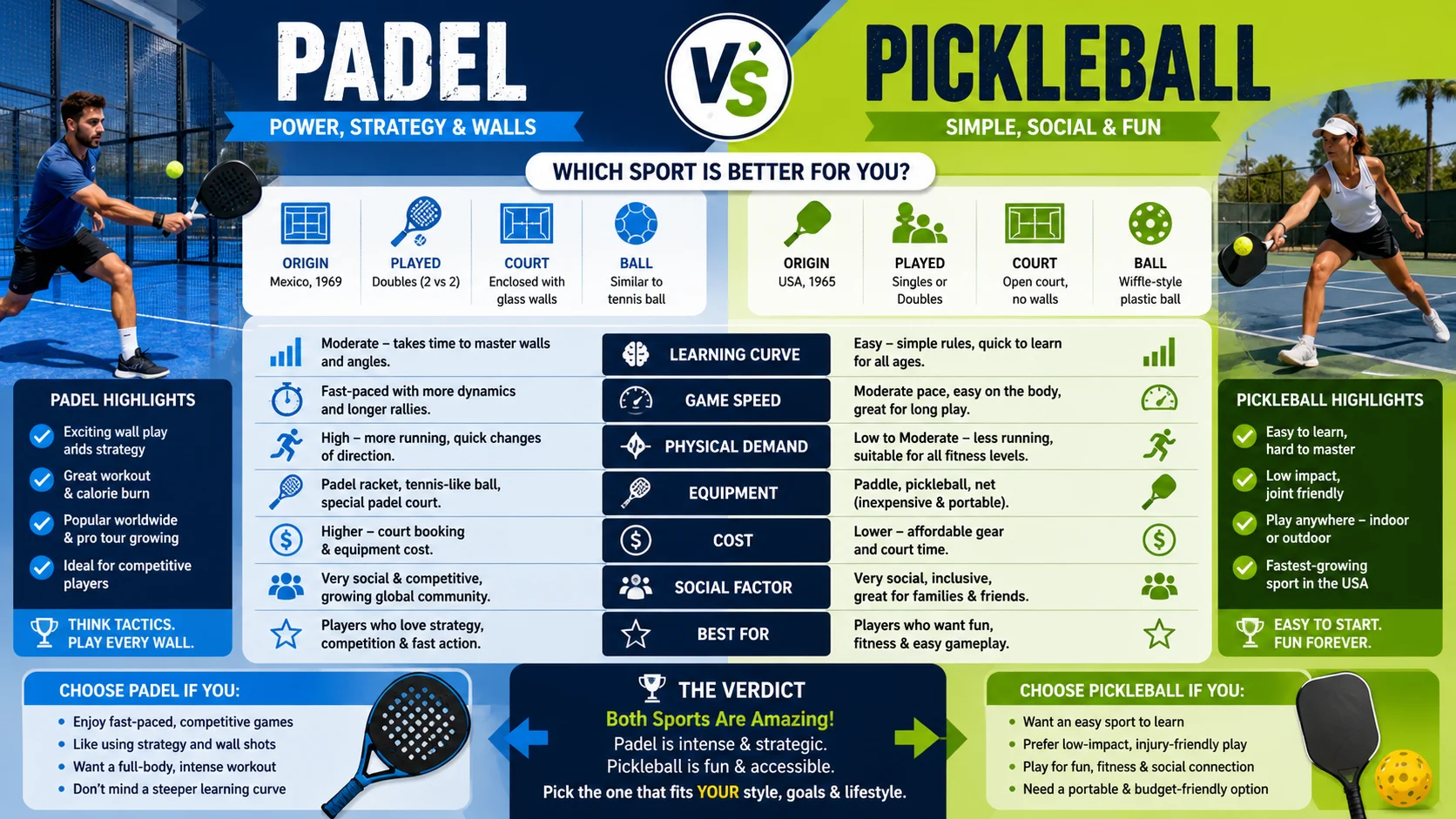
Padel is the faster, wall-based racket sport, while pickleball is smaller, simpler, and easier to learn.
Quick verdict: Choose padel for intense rallies and strategy; choose pickleball for accessibility, quick learning, and social play.
Padel vs Pickleball at a Glance
Padel and pickleball may look similar from a distance, but once you step onto the court, they feel very different. Padel uses walls, a perforated racket, a tennis-style scoring system, and longer rallies, while pickleball uses a solid paddle, perforated plastic ball, smaller court, and the famous non-volley zone or “kitchen.”
Both are excellent social sports, but the better choice depends on what you want from your game.
| Feature | Padel | Pickleball |
|---|---|---|
| Court | 10 × 20 meters | 20 × 44 feet |
| Court walls | Yes | No |
| Typical format | Doubles | Singles or doubles |
| Racket/Paddle | Perforated padel racket | Solid paddle |
| Ball | Rubber ball | Perforated plastic ball |
| Scoring | Tennis-style | Usually games to 11 |
| Serve | Underhand, after bounce | Underhand serve |
| Special feature | Walls are part of play | 7-ft non-volley zone |
| Learning curve | Moderate | Easy to moderate |
| Physical intensity | Usually higher | Variable |
| Best for | Fast rallies & tactics | Social, accessible competition |
The official International Padel Federation rules specify a 10-meter-wide by 20-meter-long enclosed court, with walls and fencing forming part of the playing environment. USA Pickleball specifies a 20-by-44-foot court for both singles and doubles.
What Is Padel?
Padel is a racket sport that combines elements of tennis and squash, but it has its own identity.
The biggest difference is simple: the walls are part of the game.
A standard padel court is enclosed by glass or other approved wall surfaces and metal fencing. Players can use the walls strategically after the ball bounces, creating angles and rallies that would be impossible in an open court sport. The FIP rules also allow authorized play outside the court in suitable facilities.
Padel is normally played as doubles, which makes communication and positioning extremely important.
Instead of simply trying to hit the ball past your opponent, you are constantly thinking:
- Where will the ball rebound?
- Should I move forward or stay back?
- Can my partner cover the middle?
- Can I create an angle off the glass?
- Should I play aggressively or reset the point?
That makes padel feel like a physical game of chess once players become comfortable with the walls.
What Is Pickleball?
Pickleball is a paddle sport played on a much smaller court with a perforated plastic ball and a solid paddle.
Its most recognizable feature is the 7-foot non-volley zone, commonly called the kitchen. Players cannot volley the ball while standing inside this zone, which creates a distinctive style of soft shots, dinks, resets, and controlled attacks.
The official USA Pickleball rules describe the court as 20 feet by 44 feet, with a tennis-style net. The sport can be played as either singles or doubles.
Pickleball also has a two-bounce rule at the beginning of each rally: after the serve, each side must allow the ball to bounce once before volleying.
That rule sounds simple, but it completely changes how points develop.
Padel vs Pickleball: Court Size
Court size is one of the clearest differences.
A padel court measures 10 × 20 meters, which is approximately 32.8 × 65.6 feet. A pickleball court measures 20 × 44 feet.
The interesting part is that padel is not simply “tennis on a smaller court.”
Its enclosed walls effectively expand the playing environment because the ball can rebound off them.
Pickleball, meanwhile, keeps the court open but makes it strategically compact.
Which court feels bigger?
Padel feels more expansive during rallies because players cover more ground and use the walls.
Pickleball feels tighter because players frequently operate close to the kitchen and net.
If you enjoy movement and chasing balls around the court, padel has the edge.
If you prefer compact positioning and quick exchanges, pickleball may feel more natural.
Padel vs Pickleball: Equipment
The equipment looks similar at first glance, but the two sports use completely different tools.
Padel racket
A padel racket is solid rather than stringed and has holes across its hitting surface. Under FIP regulations, the total racket length cannot exceed 45.5 cm, and the racket face is perforated with holes.
Padel rackets commonly come in:
- Round shapes
- Teardrop shapes
- Diamond shapes
These shapes influence balance, control, and power.
Pickleball paddle
A pickleball paddle has a solid hitting surface and is generally shorter than a tennis racket.
USA Pickleball’s equipment standards limit the combined length and width of the paddle to 24 inches, while paddle length itself cannot exceed 17 inches.
The difference is important because paddle design strongly affects the style of play.
Padel: racket control + spin + power + wall interaction.
Pickleball: paddle control + placement + spin + soft hands.
Padel vs Pickleball: Ball Differences
The balls are completely different.
A padel ball is a rubber ball similar in appearance to a tennis ball, with FIP specifications covering its size, weight, bounce, and pressure.
Pickleball uses a perforated plastic ball.
This difference changes everything.
The pickleball’s holes reduce its speed and create a unique flight pattern. Padel’s rubber ball behaves more like a conventional racket-sport ball and interacts dramatically with the walls.
If you’ve played tennis before, the padel ball may feel more familiar.
If you’ve never played racket sports, the pickleball ball can make the game feel less intimidating.
Padel vs Pickleball: Rules
This is where the sports really separate.
Padel rules
Padel uses a tennis-style scoring system:
Love → 15 → 30 → 40 → Game
A standard set is won by the first pair to reach six games with a two-game advantage, with a tie-break at 6–6 under the standard format. Matches are generally best of three sets.
The serve must be made after bouncing the ball, and the ball is struck at or below waist height. The serve travels diagonally into the opponent’s service box.
The walls then become an important tactical weapon once the rally is underway.
Pickleball rules
Pickleball normally uses numeric scoring, with games commonly played to 11 points, requiring a two-point margin under standard scoring.
The sport’s two-bounce rule means the serve and return must bounce before normal volleying begins. After that, players can move toward the non-volley zone and engage in fast exchanges.
So the basic contrast is:
Padel: tennis-style scoring + walls.
Pickleball: numeric scoring + kitchen + two-bounce rule.
Which Is Easier to Learn?
Winner: Pickleball
For most complete beginners, pickleball is easier to start.
The court is smaller, the equipment is simple, and basic rallies can become enjoyable relatively quickly.
That doesn’t mean pickleball is easy at an advanced level.
Far from it.
At higher levels, players must master:
- Dinks
- Third-shot drops
- Resets
- Drives
- Speed-ups
- Kitchen positioning
- Transition-zone play
- Paddle battles
Padel has a steeper early learning curve because beginners have to understand not only racket technique but also how and when to use the walls.
The first few sessions can feel confusing.
Then something clicks and the walls suddenly become your best friend.
Which Is More Physically Demanding?
Winner: Padel
Padel generally demands more movement across the court.
Players sprint, turn, recover, bend, reach, and frequently change direction. The walls also create unpredictable-looking situations that require quick reactions.
Pickleball can still provide an excellent workout, especially during competitive doubles or singles, but its smaller court reduces the amount of ground that most players need to cover.
However, don’t make the mistake of calling pickleball a “light” sport.
Fast kitchen exchanges can be brutally demanding on reaction time, balance, and concentration.
Which Sport Is More Social?
Winner: Pickleball
Both sports are highly social, but pickleball has a particularly strong recreational and community-oriented culture.
Doubles play, open-play sessions, recreational leagues, and relatively easy entry make it attractive to people who want competition without making the sport their entire lifestyle.
Padel is also exceptionally social because doubles is central to the sport.
If your goal is meeting people, playing casually, and getting into games quickly, pickleball has a slight advantage.
If you already have a group of four friends, padel can be incredibly addictive.
Which Is More Strategic?
Winner: It Depends
Padel strategy revolves heavily around:
- Wall rebounds
- Lob placement
- Net positioning
- Partner movement
- Angles
- Defensive transitions
- Creating pressure
Pickleball strategy revolves more around:
- Shot placement
- Dinking
- Kitchen control
- Patience
- Third-shot drops
- Resets
- Paddle battles
In padel, you may win a point because you understand the geometry of the court better.
In pickleball, you may win because you were willing to hit the softer shot instead of the harder one.
Both reward intelligence but in different ways.
Padel vs Pickleball: Which Is Faster?
Padel feels faster overall
Padel rallies can involve powerful smashes, quick volleys, wall rebounds, and rapid transitions.
Pickleball can also become extremely fast, particularly at the kitchen line, where players react to balls from very short distances.
So the distinction is:
Padel: more movement and larger attacking sequences.
Pickleball: more compact reaction battles and hand speed.
If you like explosive movement, choose padel.
If you love lightning-fast hands at the net, pickleball may be your game.
Padel vs Pickleball: Which Is Better for Beginners?
| If you want… | Better choice |
|---|---|
| Easy first session | Pickleball |
| Simple equipment | Pickleball |
| Smaller court | Pickleball |
| Wall-based rallies | Padel |
| More running | Padel |
| Tennis-like scoring | Padel |
| Kitchen strategy | Pickleball |
| Doubles competition | Both |
| Quick social games | Pickleball |
| Advanced tactical depth | Both |
Padel vs Pickleball for Tennis Players
If you’re coming from tennis, padel may feel more familiar initially because of the scoring format, serve structure, rally dynamics, and racket-sport movement.
But don’t assume your tennis habits automatically transfer.
The walls change shot selection dramatically.
Pickleball can also suit tennis players, but the smaller court and paddle require adjustments. Tennis players often have to learn to control power and develop softer hands rather than simply hitting through the ball.
In other words:
Tennis → Padel: easier physical transition, bigger tactical adjustment.
Tennis → Pickleball: easier court transition, bigger adjustment to pace and touch.
Padel vs Pickleball: Which Is More Fun?
This one is personal but here’s a useful test.
Choose padel if you enjoy:
- Long rallies
- Glass walls
- Fast movement
- Doubles teamwork
- Aggressive attacking
- Spin and lobs
- Tactical court positioning
Choose pickleball if you enjoy:
- Quick learning
- Smaller courts
- Social doubles
- Dinks and soft shots
- Fast hand battles
- Strategic patience
- Easy recreational entry
The sport you find more fun is usually the one you will actually keep playing.
And consistency matters more than choosing the “perfect” sport.
Is Padel Harder Than Pickleball?
Yes, usually at the beginning.
Padel asks beginners to understand the court, walls, bounce patterns, positioning, serve, and partner movement.
Pickleball has fewer concepts to learn before you can participate in a basic rally.
But advanced pickleball is not necessarily easier than advanced padel.
Once players reach competitive levels, both sports require exceptional timing, decision-making, positioning, anticipation, and technical control.
Padel vs Pickleball: Final Verdict
There is no universal winner.
Pickleball wins for accessibility, simplicity, and beginner-friendly social play.
Padel wins for intensity, wall-based strategy, movement, and the excitement of extended doubles rallies.
If you’re completely new to racket sports and want something you can understand quickly, start with pickleball.
If you want a more dynamic court, enjoy doubles, and love the idea of using walls as part of your strategy, try padel.
And if you’re still undecided?
Play both.
You may discover that pickleball becomes your easy weeknight game while padel becomes the sport you can’t stop thinking about on the drive home.
Frequently Asked Questions
Is padel the same as pickleball?
No. Padel and pickleball are different sports with different courts, equipment, balls, scoring systems, and playing styles. Padel uses enclosed walls, while pickleball uses an open court with a 7-foot non-volley zone.
Is padel harder than pickleball?
Padel is generally harder for beginners because players must learn wall rebounds and more complex court positioning. Advanced pickleball can also be highly technical and demanding.
Which is better, padel or pickleball?
It depends on your goals. Pickleball is generally better for easy entry and social recreational play, while padel is better for players who want more movement, wall play, and doubles strategy.
Can tennis players play padel?
Absolutely. Tennis players usually have a useful foundation in racket control, movement, serving, and scoring, although they must learn how to use the walls and adjust their positioning.
Can tennis players play pickleball?
Yes. Tennis players can transition to pickleball relatively quickly, but they need to adjust to the smaller court, paddle, slower ball, kitchen rules, and softer style of play.
Which has a bigger court, padel or pickleball?
Padel has the larger court. A standard padel court is 10 × 20 meters, while a pickleball court is 20 × 44 feet.
Is pickleball easier to learn than padel?
For most beginners, yes. Pickleball’s smaller court and straightforward basic rules make it easier to start playing, while padel requires players to understand wall rebounds and enclosed-court positioning.
The Bottom Line
Padel vs pickleball isn’t really about which sport is “better.” It’s about which experience you want.
Pickleball is the easy-to-enter, social, tactical game that gets you playing quickly.
Padel is the faster, more physical, wall-driven doubles battle that rewards movement, teamwork, and tactical creativity.
If you want simple and social, choose pickleball. If you want fast and strategic, choose padel.