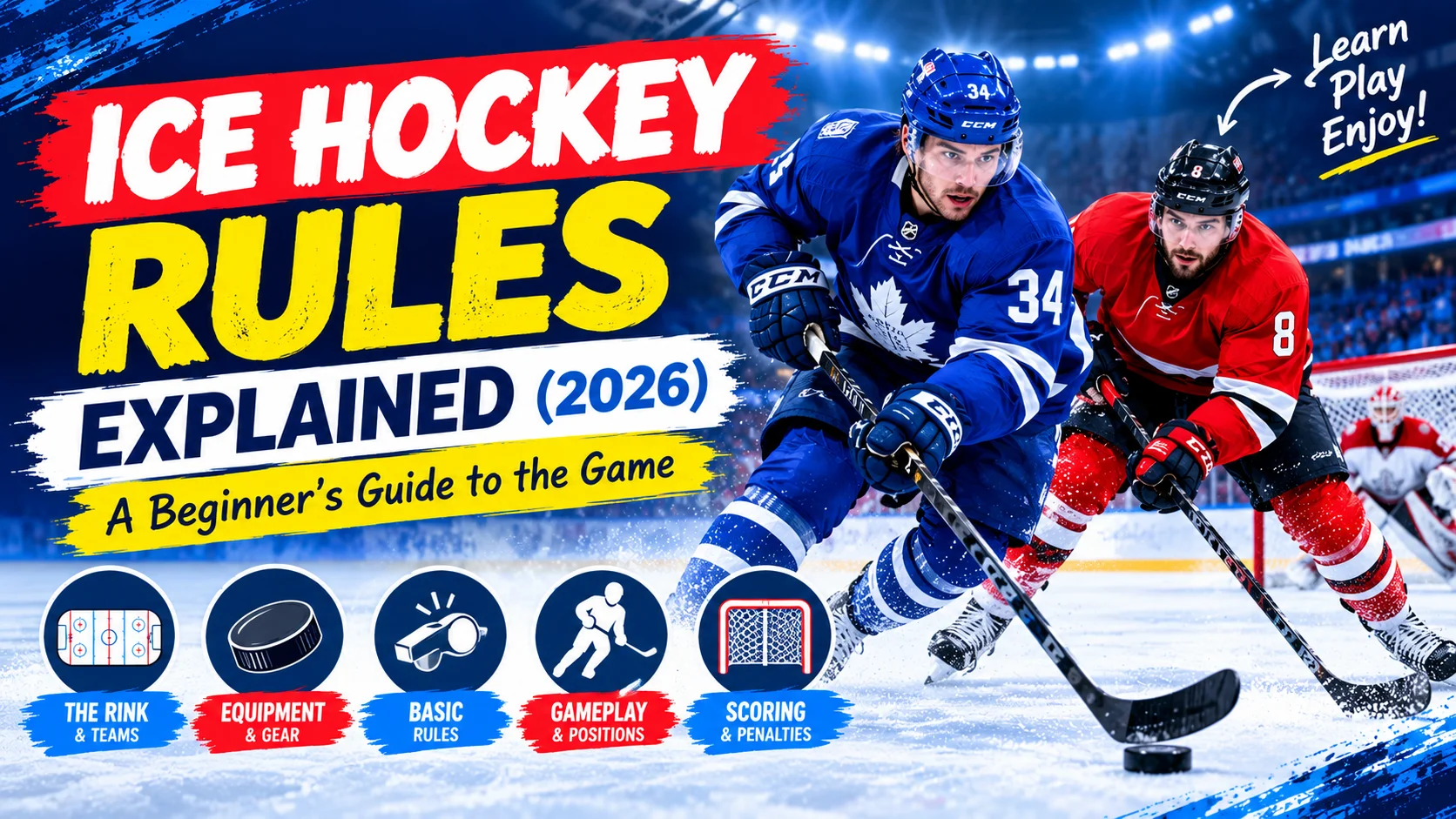
Ice hockey is played by two teams trying to score by shooting a puck into the opponent’s net. Learn the essential rules, penalties, offsides, icing, and scoring in this beginner-friendly guide.
Ice Hockey Rules at a Glance
Ice hockey looks fast and physical, but its basic rules are easy to understand once you know what to watch for. The objective is simple: score more goals than the opposing team before time runs out.
| Rule | How It Works |
|---|---|
| Players on the ice | Usually 6 per team, including the goalie |
| Game length | 3 periods of 20 minutes in standard NHL play |
| Scoring | 1 goal for each puck legally entering the net |
| Offside | Attacking players cannot enter the offensive zone ahead of the puck |
| Icing | Certain long shots sent across the opponent’s goal line are stopped |
| Minor penalty | Usually 2 minutes in the penalty box |
| Major penalty | Usually 5 minutes |
| Faceoff | Restarts play by dropping the puck between opposing players |
Note: Exact rules can vary between the NHL, international competitions, college hockey, and youth leagues.
How Does Ice Hockey Work?
Ice hockey is played on a rink where players use curved sticks to pass, control, and shoot a hard rubber puck. The team with the most goals at the end wins.
Each team typically has six players on the ice:
- Three forwards: Center, left wing, and right wing. Their primary job is to create scoring opportunities.
- Two defensemen: Protect their own goal and help move the puck forward.
- One goalie: Tries to stop the puck from entering the net.
Teams can replace players while play continues. These substitutions are called line changes, and they help players maintain speed and energy throughout the game.
How Long Is an Ice Hockey Game?
A standard NHL game has three periods, each lasting 20 minutes of playing time, for 60 minutes of regulation hockey.
There are intermissions between periods. Because the clock stops for many interruptions, a real game usually lasts considerably longer than 60 minutes.
If the score is tied at the end of regulation, overtime or a shootout may follow, depending on the competition and stage of the game.
In the NHL regular season, overtime is typically five minutes of three-on-three sudden-death play. If neither team scores, a shootout decides the winner. Playoff overtime uses different rules, generally continuing in full periods until a goal is scored.
How Do You Score in Ice Hockey?
A team scores when the entire puck legally crosses the goal line between the goalposts and beneath the crossbar.
Each goal counts as one point on the scoreboard. The team that scores the most goals wins.
However, not every puck that enters the net counts. Officials may disallow a goal if, for example:
- An attacking player deliberately kicks the puck into the net.
- A player illegally directs the puck with a high stick.
- An attacking player interferes with the goalie.
- An offside violation or another relevant infraction affects the play.
The exact decision depends on the applicable rule and the circumstances of the goal.
What Is Offside in Ice Hockey?
Offside occurs when an attacking player enters the offensive zone before the puck legally crosses the blue line.
The blue lines divide the rink into zones. For a legal zone entry, the puck must cross the attacking blue line before the attacking players have fully entered the offensive zone.
Example of an offside violation
Imagine a forward skating toward the opponent’s goal. If both skates cross the blue line before the puck enters the zone, the play may be ruled offside.
If the puck crosses first and the attacking players enter legally, play can continue.
An offside call usually results in a stoppage and a faceoff. Some competitions use delayed or tag-up offside procedures, so the precise application can vary.
Remember: Watch the puck and the blue line together. That is the easiest way to understand most offside calls.
What Is Icing in Ice Hockey?
Icing generally occurs when a team shoots the puck from its own side of the center red line across the opponent’s goal line without another player touching it, subject to the applicable rule.
The purpose is to discourage teams from simply firing the puck the length of the rink to escape pressure.
Example of icing
A defender under pressure shoots the puck from behind the center line. It travels past the opposing goal and crosses the goal line without being touched. If the conditions for icing are met, the referee stops play.
The resulting faceoff is generally brought back to the offending team’s defensive zone.
Icing exceptions differ by competition. For example, rules about icing while shorthanded are not identical across all leagues and age groups.
Offside vs. icing: What is the difference?
| Offside | Icing |
|---|---|
| Concerns entering the offensive zone illegally | Concerns sending the puck too far down the rink |
| Involves the attacking blue line | Involves the center line and opposing goal line |
| Often occurs during a rush | Often occurs when a team clears the puck |
| Usually results in a faceoff after a zone-entry violation | Usually results in a defensive-zone faceoff for the offending team |
Ice Hockey Penalties Explained
Penalties are called when players break rules involving illegal contact, stick use, interference, or other prohibited actions. Depending on the violation, a player may be sent to the penalty box, leaving their team short-handed.
Minor penalty — usually 2 minutes
Common examples include tripping, hooking, holding, and certain forms of interference.
During a standard minor penalty, the offending team usually plays with one fewer skater. If the opposing team scores a power-play goal, the minor penalty generally ends early, subject to the applicable rules.
Major penalty — usually 5 minutes
A major penalty is assessed for more serious infractions, such as certain dangerous hits or severe forms of illegal contact.
Unlike a standard minor penalty, a major penalty generally does not end just because the opposing team scores.
Misconduct penalty
A misconduct penalty removes a player from the ice for a specified period, commonly 10 minutes in the NHL. Whether the team must play short-handed depends on the penalty and any additional penalties assessed.
Penalty shot
A penalty shot gives an eligible attacking player a one-on-one opportunity against the goalie. It can be awarded for specific infractions that unfairly deny a scoring opportunity, according to the relevant rules.
What does power play mean?
A power play occurs when one team has more skaters on the ice because an opponent is serving a penalty.
The team with fewer skaters is shorthanded. Power plays create valuable scoring opportunities because the attacking team has more space to move the puck and create shots.
What Is Body Checking in Ice Hockey?
Body checking is a physical technique used to separate an opponent from the puck or limit their movement. It is not permission to hit anyone in any way.
Illegal actions can include charging, boarding, checking from behind, and certain forms of head contact. The rules depend on the type of contact, the situation, and the competition.
Body-checking permissions also vary by league and age level. Youth hockey often has restrictions designed to protect developing players.
Can Players Use Their Hands or Feet?
Players may use their hands and feet in certain situations, but not every action is legal.
- Hand pass: Players can use a hand to stop or knock the puck down in permitted circumstances, but a hand pass to a teammate may be prohibited, especially in the attacking zone.
- Kicking the puck: Players can use their skates to direct the puck in many situations, but a goal scored by deliberately kicking the puck into the net is generally disallowed.
- High-sticking the puck: Playing the puck with a stick above the permitted height can result in a stoppage. A high-sticked puck entering the net is generally not counted as a goal.
- Goalie restrictions: Goalies have special privileges and equipment, but they must still follow rules governing puck handling and play around the net.
These rules help maintain fair play while allowing players to control the puck creatively.
What Happens During a Faceoff?
A faceoff restarts play after a stoppage. Two opposing players line up at a designated faceoff spot, and an official drops the puck between them.
Both players attempt to gain possession and direct the puck toward their teammates.
Faceoffs occur at the beginning of periods and after goals, icing, offside calls, and other stoppages. The exact faceoff location depends on the reason play stopped and the applicable rules.
Winning a faceoff can give a team immediate control of the puck and a chance to launch an attack.
Ice Hockey Overtime and Shootout Rules
When a game is tied after regulation, the next step depends on the competition.
NHL regular season: Teams typically play five minutes of three-on-three sudden-death overtime. The first goal wins. If nobody scores, a shootout follows.
NHL playoffs: Teams play additional sudden-death overtime periods, generally at five-on-five, until a goal decides the game. There is no regular-season-style shootout to decide a playoff game.
International and other competitions: Overtime duration, player strength, and shootout procedures can differ depending on tournament regulations.
Always check the competition’s rules before assuming every tied game is decided the same way.
What Equipment Is Required in Ice Hockey?
Ice hockey is a fast, physical sport, so protective equipment is essential. Requirements vary by league, age, and competition.
Typical equipment includes:
- Helmet and required face protection
- Hockey stick
- Skates
- Shoulder and elbow pads
- Gloves
- Shin guards
- Protective pants
- Athletic protection
- Goalie-specific pads, blocker, catching glove, and mask for goalies
Players should use properly fitted, approved equipment and follow their league’s safety requirements.
Common Ice Hockey Terms Every Beginner Should Know
| Term | Meaning |
|---|---|
| Puck | The hard rubber disc used to play |
| Goal | A successful score |
| Assist | Credit given for helping set up a goal |
| Power play | A team has a numerical advantage due to an opponent’s penalty |
| Shorthanded | A team has fewer skaters because of a penalty |
| Hat trick | A player scores three goals in one game |
| Empty-net goal | A goal scored while the opposing goalie is off the ice |
| Save | The goalie prevents a shot from entering the net |
| Forecheck | Pressuring the opponent in their defensive zone |
| Backcheck | Skating back to help defend against an attack |
Frequently Asked Questions
How many players are on the ice in hockey?
Each team typically has six players on the ice: five skaters and one goalie. Penalties can reduce a team’s number of skaters.
How many periods are in an ice hockey game?
Standard NHL games have three 20-minute periods, totaling 60 minutes of regulation playing time.
Can you kick the puck in hockey?
Players can direct the puck with their skates in many situations, but deliberately kicking the puck into the goal generally does not count as a goal.
What is the difference between icing and offside?
Offside concerns an attacking player entering the offensive zone ahead of the puck. Icing generally concerns shooting the puck from behind the center line across the opponent’s goal line without a qualifying touch.
How long does a hockey penalty last?
A minor penalty usually lasts two minutes, while a major penalty usually lasts five minutes. Other penalties have different durations and consequences.
Is fighting allowed in ice hockey?
Fighting is penalized, even though enforcement and consequences vary by league. Players may receive major penalties and additional misconduct or game penalties. Fighting is not a standard or required part of the sport.
What happens if the puck goes out of play?
Officials stop play, and the game restarts with a faceoff at the appropriate location. The location depends on how and where the puck left the playing surface.
Can a goalie score a goal?
Yes. A goalie can score if they legally shoot or otherwise propel the puck into the opponent’s net, although it is rare.
Final Thoughts
Understanding ice hockey rules makes the game far more exciting. Start by learning how goals are scored, how offside and icing work, and why penalties create power plays. Once these basics become familiar, faceoffs, line changes, defensive plays, and overtime decisions become much easier to follow.
One important tip: rules can differ between the NHL, IIHF international hockey, college hockey, and youth competitions. For the most accurate interpretation, consult the official rulebook for the league you are watching or playing in.

Emily Parker is a sports journalist at SportsOrbitX.com with a passion for covering cricket, tennis and major international sporting events. She is committed to producing clear, reliable and engaging content for sports enthusiasts worldwide.