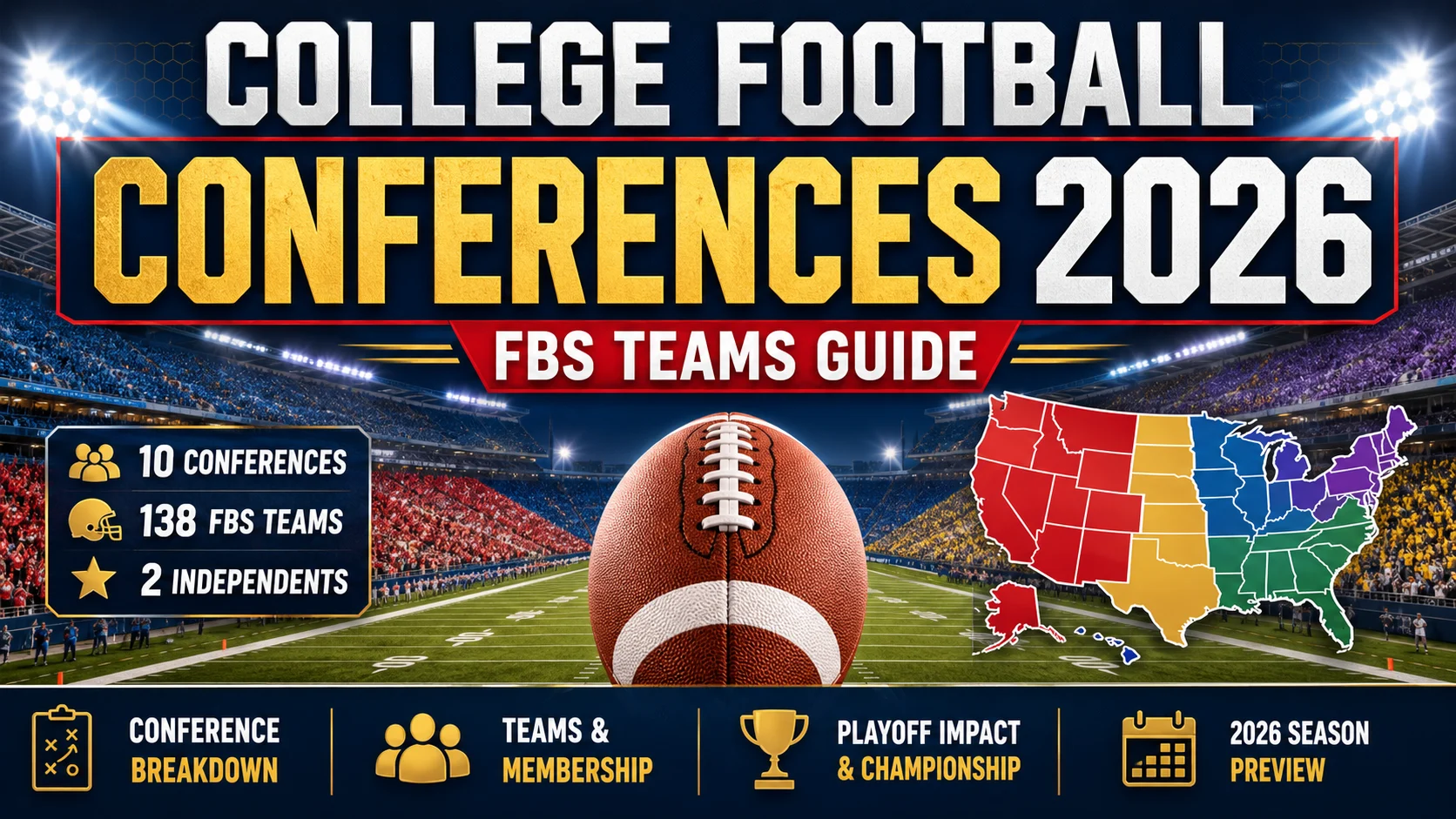
College football conferences are leagues that organize FBS teams for regular-season competition, conference championships, and postseason access. In 2026, the FBS has 10 conferences plus independent teams, with the ACC, Big Ten, Big 12, and SEC forming the Power 4.
What Are College Football Conferences?
College football conferences are groups of universities that compete against one another under a shared league structure. They determine conference schedules, standings, championship games and most importantly play a major role in the road to the College Football Playoff (CFP).
For the 2026 season, the Football Bowl Subdivision (FBS) has 138 teams across 10 conferences, plus Notre Dame and UConn as football independents. The four biggest conferences the ACC, Big Ten, Big 12, and SEC are collectively known as the Power 4.
But college football isn’t as simple as “big conference vs. small conference.” The 2026 landscape has been reshaped by realignment, including the return of the Pac-12 as an eight-team football conference and major membership changes in the Mountain West.
College Football Conferences at a Glance
| Conference | 2026 Football Teams | Group |
|---|---|---|
| Big Ten | 18 | Power 4 |
| ACC | 17 | Power 4 |
| Big 12 | 16 | Power 4 |
| SEC | 16 | Power 4 |
| American Athletic Conference | 14 | Group of 6 |
| Sun Belt | 14 | Group of 6 |
| MAC | 13 | Group of 6 |
| Conference USA | 10 | Group of 6 |
| Mountain West | 10 | Group of 6 |
| Pac-12 | 8 | Group of 6 |
| Independents | 2 | Independent |
| Total FBS | 138 |
The ACC has 18 member institutions overall, but Notre Dame remains independent in football, leaving 17 ACC football teams.
What Are the Power 4 Conferences?
The Power 4 are the ACC, Big Ten, Big 12, and SEC. These conferences sit at the center of modern college football because of their national brands, financial resources, television exposure, recruiting strength, and direct position in the CFP structure.
Starting with the 2026 season, each Power 4 conference champion receives an automatic CFP bid.
1. Big Ten Conference
The Big Ten is the largest FBS conference by football membership, with 18 teams in 2026.
Its membership includes:
- Illinois
- Indiana
- Iowa
- Maryland
- Michigan
- Michigan State
- Minnesota
- Nebraska
- Northwestern
- Ohio State
- Oregon
- Penn State
- Purdue
- Rutgers
- UCLA
- USC
- Washington
- Wisconsin
The conference became much more geographically diverse after adding Oregon, UCLA, USC, and Washington in 2024.
Why it matters: The Big Ten combines historic Midwestern programs with major West Coast brands, creating one of the deepest conference schedules in the country.
2. SEC — Southeastern Conference
The SEC has 16 football teams and is synonymous with elite college football competition.
Its teams are:
- Alabama
- Arkansas
- Auburn
- Florida
- Georgia
- Kentucky
- LSU
- Mississippi State
- Missouri
- Ole Miss
- Oklahoma
- South Carolina
- Tennessee
- Texas
- Texas A&M
- Vanderbilt
Oklahoma and Texas are part of the SEC after leaving the Big 12, further strengthening an already powerful conference.
Why it matters: The SEC routinely features nationally prominent programs, intense rivalries, deep recruiting talent, and some of the toughest weekly schedules in college football.
3. Big 12 Conference
The Big 12 has 16 football teams in 2026:
- Arizona
- Arizona State
- Baylor
- BYU
- Cincinnati
- Colorado
- Houston
- Iowa State
- Kansas
- Kansas State
- Oklahoma State
- TCU
- Texas Tech
- UCF
- Utah
- West Virginia
The modern Big 12 looks dramatically different from the conference of a decade ago. Oklahoma and Texas departed for the SEC, while Arizona, Arizona State, Colorado, and Utah joined in 2024.
Why it matters: The Big 12 has become one of the most geographically diverse conferences, stretching across multiple regions of the United States.
4. ACC — Atlantic Coast Conference
The ACC has 18 member institutions, although Notre Dame remains independent in football. Its 17 football teams are:
- Boston College
- California
- Clemson
- Duke
- Florida State
- Georgia Tech
- Louisville
- Miami
- NC State
- North Carolina
- Pitt
- SMU
- Stanford
- Syracuse
- Virginia
- Virginia Tech
- Wake Forest
Notre Dame is a full ACC member in most sports but continues to play independent football.
The addition of California, Stanford, and SMU in 2024 expanded the ACC’s national footprint significantly.
What Are the Group of 6 Conferences?
The Group of 6 (G6) consists of the American Athletic Conference, Conference USA, MAC, Mountain West, Pac-12, and Sun Belt.
These conferences don’t have the same automatic CFP structure as the Power 4, but they can still put teams into the playoff.
In 2026, the highest-ranked team from the American, CUSA, MAC, Mountain West, Pac-12, or Sun Belt receives the fifth automatic CFP bid.
That change makes the G6 race especially important.
American Athletic Conference
The American, commonly called the AAC, has 14 football teams in 2026:
- Army
- Charlotte
- East Carolina
- Florida Atlantic
- Memphis
- Navy
- North Texas
- Rice
- Temple
- Tulane
- Tulsa
- UAB
- USF
- UTSA
Army and Navy add a unique service-academy tradition to the conference, while programs such as Memphis, Tulane, and USF provide significant competitive history.
The American’s 2026 schedule includes 14 teams playing eight conference games each.
Conference USA
Conference USA has 10 football teams in 2026:
- Delaware
- FIU
- Jacksonville State
- Kennesaw State
- Liberty
- Middle Tennessee
- Missouri State
- New Mexico State
- Sam Houston
- Western Kentucky
CUSA is one of the more geographically diverse conferences and has embraced midweek football games as part of its television strategy.
Mid-American Conference
The MAC has 13 football teams in 2026.
The conference is known for producing competitive games, developing NFL talent, and providing opportunities for programs that don’t have the enormous athletic budgets of the Power 4.
Its 2026 membership also includes Sacramento State, which moved up from the FCS level.
Mountain West Conference
The Mountain West has 10 football teams in 2026:
- Air Force
- Hawai‘i
- Nevada
- New Mexico
- Northern Illinois
- North Dakota State
- San José State
- UNLV
- UTEP
- Wyoming
The conference underwent one of the biggest transformations of 2026. Boise State, Colorado State, Fresno State, San Diego State, and Utah State left for the new Pac-12, while UTEP, Northern Illinois, and North Dakota State joined the Mountain West football lineup.
North Dakota State’s arrival is particularly notable because 2026 is its first season as an FBS program.
Pac-12 Conference
Yes the Pac-12 is back as a football conference in 2026.
The rebuilt Pac-12 has eight football-playing members:
- Boise State
- Colorado State
- Fresno State
- Oregon State
- San Diego State
- Texas State
- Utah State
- Washington State
Gonzaga is also a full Pac-12 member but does not sponsor FBS football. The conference officially launched its new membership structure on July 1, 2026.
This is one of the most interesting developments in the modern college football landscape.
Sun Belt Conference
The Sun Belt has 14 football teams and has developed a reputation for competitive programs and exciting games.
Its membership includes schools such as Appalachian State, Coastal Carolina, Georgia Southern, Georgia State, James Madison, Louisiana, Marshall, Old Dominion, South Alabama, Southern Miss, Texas State, Troy, and others.
The conference has also been affected by realignment, with Louisiana Tech moving from CUSA to the Sun Belt for 2026.
College Football Independents
Not every FBS team belongs to a conference.
For 2026, the two football independents are:
- Notre Dame
- UConn
Notre Dame is the most prominent independent program. Although it has an extensive relationship with the ACC, its football program does not compete as an ACC member.
The CFP also gives Notre Dame a special path: if the Fighting Irish rank inside the final CFP Top 12, they receive an automatic bid.
How Do College Football Conferences Affect the CFP?
This is where conference membership becomes extremely important.
The 2026–27 College Football Playoff has 12 teams.
The automatic qualification structure is:
4 Power 4 champions + 1 highest-ranked G6 team + 7 at-large teams
The four Power 4 champions come from:
- ACC
- Big Ten
- Big 12
- SEC
The fifth automatic spot goes to the highest-ranked team from the six G6 conferences.
The remaining seven places are awarded to the highest-ranked eligible teams regardless of conference.
Why This Matters
A team doesn’t necessarily need to win its conference to reach the CFP.
For example, a strong SEC or Big Ten team that finishes second or third can still earn an at-large spot if its overall resume is good enough.
That creates two different paths:
Win your conference → automatic bid
Build an elite national resume → at-large bid
This makes conference races important even for teams that aren’t likely to win the league championship.
Why Are College Football Conferences Changing So Much?
Conference realignment has transformed college football.
Schools move because of factors such as:
- Television revenue
- Media rights
- National exposure
- Recruiting advantages
- Travel considerations
- Competitive opportunities
- Institutional partnerships
- Long-term financial stability
The result is a college football map that looks very different from just a few years ago.
The Big Ten now stretches to the West Coast, the SEC includes Texas and Oklahoma, the ACC has California and Stanford, and the Pac-12 has rebuilt itself with eight football programs.
Power 4 vs. Group of 6: What’s the Difference?
| Feature | Power 4 | Group of 6 |
|---|---|---|
| Conferences | ACC, Big Ten, Big 12, SEC | American, CUSA, MAC, Mountain West, Pac-12, Sun Belt |
| 2026 CFP Automatic Path | Conference champion | Highest-ranked G6 team |
| National Exposure | Generally highest | Varies |
| Financial Resources | Generally greater | Generally lower |
| Competition | Elite depth | Highly competitive |
| Can Reach CFP? | Yes | Yes |
The gap between the groups is significant financially, but the G6 remains extremely important because one team receives an automatic CFP place under the 2026 format.
What Is the Best College Football Conference?
There is no single objective answer.
If you’re judging by recent national success and depth, the SEC is usually near the top of the conversation.
If you’re looking at conference size and national reach, the Big Ten stands out.
If you’re evaluating recent expansion and geographic diversity, the ACC and Big 12 have fascinating cases.
And if you’re looking for competitive unpredictability, the Group of 6 conferences can provide some of the most entertaining matchups.
The “best” conference ultimately depends on whether you’re measuring championships, rankings, recruiting, revenue, depth, or overall competitiveness.
College Football Conferences in 2026: The Big Picture
The 2026 season represents one of the biggest structural shifts in college football history.
The Power 4 remains the center of the sport, but the rebuilt Pac-12, revamped Mountain West, and evolving Group of 6 create a much more complicated national landscape.
And the CFP has made conference races even more meaningful. Four Power 4 champions receive automatic access, while the highest-ranked team from the six G6 leagues earns another automatic spot. Notre Dame also has its own special route if it finishes in the CFP Top 12.
So when you see a college football team climbing the rankings, don’t look only at its win-loss record.
Look at its conference, its conference opponents, its championship path, and its national resume.
That’s what makes understanding college football conferences so important in the modern era.
Frequently Asked Questions
How many college football conferences are there?
In the 2026 FBS, there are 10 conferences, plus independent teams. The FBS has 138 teams in total.
What are the Power 4 conferences?
The Power 4 consists of the ACC, Big Ten, Big 12, and SEC.
What are the Group of 6 conferences?
The G6 consists of the American, Conference USA, MAC, Mountain West, Pac-12, and Sun Belt.
Is the Pac-12 still a college football conference?
Yes. The Pac-12 returned with an eight-team football membership for the 2026 season, led by Oregon State and Washington State along with six new football members.
Can a Group of 6 team make the College Football Playoff?
Yes. In 2026, the highest-ranked team from the American, CUSA, MAC, Mountain West, Pac-12, or Sun Belt receives an automatic CFP bid.
Is Notre Dame in a conference?
Notre Dame is an ACC member in most sports but remains independent in football. If Notre Dame ranks in the CFP Top 12 on Selection Day, it receives an automatic CFP bid under the 2026 format.
Which college football conference has the most teams?
The Big Ten has the most FBS football teams in 2026, with 18 members.
What is the biggest change to college football conferences in 2026?
One of the biggest changes is the relaunch of the Pac-12, which now has eight football-playing members, while several former Mountain West teams moved into the rebuilt league. The Mountain West also added UTEP, Northern Illinois, and North Dakota State.
Final Thoughts
College football conferences are more than groups of teams they shape schedules, rivalries, championships, recruiting, television exposure and the path to the College Football Playoff.
In 2026, the sport is defined by the Power 4, an increasingly competitive Group of 6, a rebuilt Pac-12 and independent programs such as Notre Dame and UConn. With conference realignment continuing to reshape the landscape, understanding where each team belongs is now essential for following college football intelligently.
And that’s the real story of college football conferences: the map has changed, but the stakes have never been higher.

Daniel Brooks is a sports writer at SportsOrbitX.com, specializing in football, basketball and global sports news. He focuses on delivering accurate reporting, match analysis and timely updates that keep fans informed.