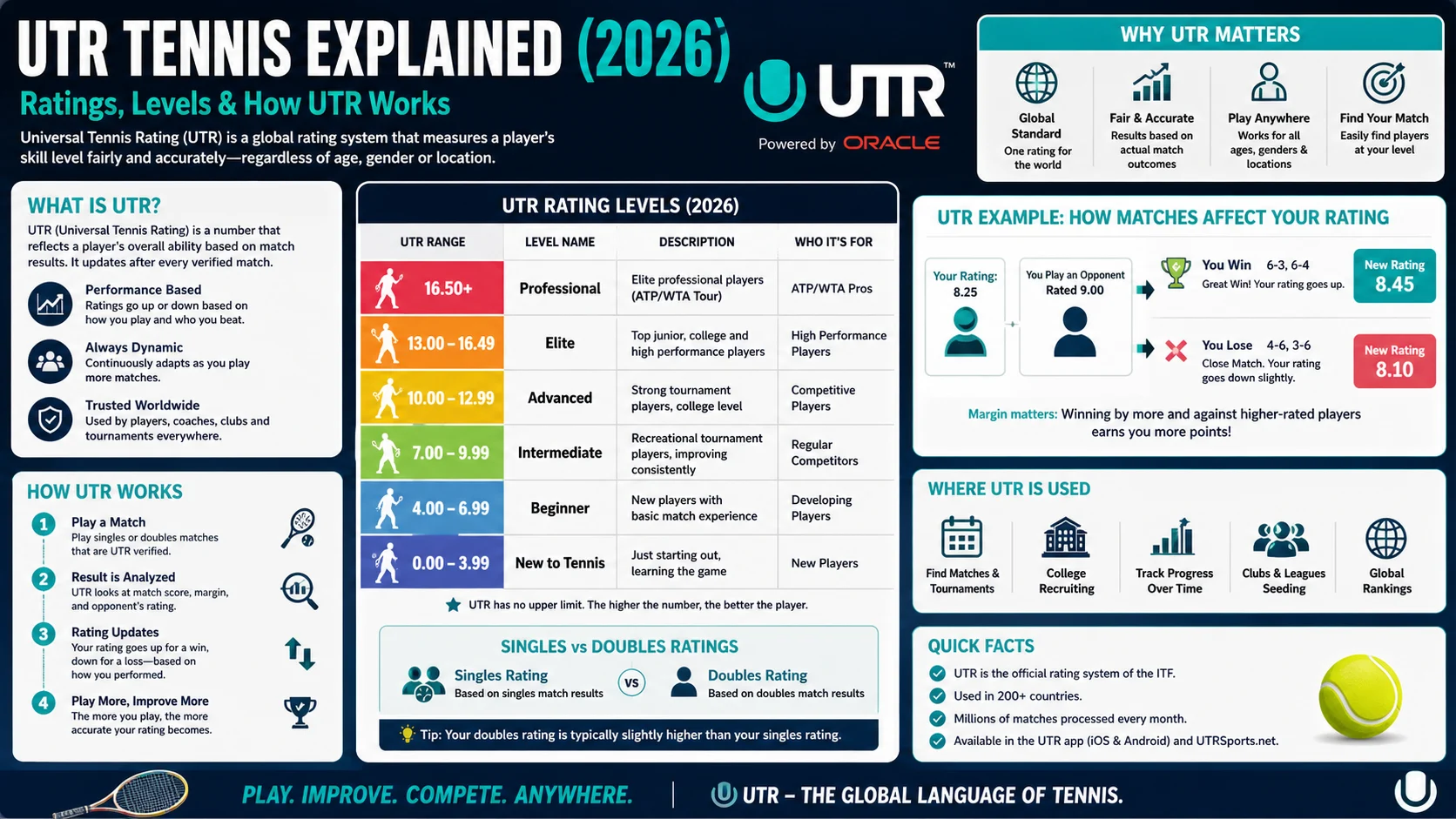
UTR Tennis is a global skill-based rating system that measures a player’s performance on a 1.00–16.50 scale. Unlike ATP and WTA rankings, UTR focuses on how competitively you play, including the percentage of games you win against your opponents.
If you have ever searched “What is UTR in tennis?”, “What is a good UTR?”, or “How does UTR work?”, the answer goes beyond a simple number.
UTR has become an important part of modern tennis because it gives players of different ages, genders, locations, and competitive backgrounds a common way to measure playing level. It is used by recreational players, juniors, coaches, clubs, tournament organizers, and college tennis programs.
What Is UTR Tennis?
UTR stands for Universal Tennis Rating. It is a dynamic tennis rating system designed to measure a player’s actual competitive level rather than simply counting tournament wins or losses.
Every player receives a rating between 1.00 and 16.50. The rating can rise or fall as new match results are recorded. UTR Sports says one match can produce a projected rating, while additional results make the rating increasingly reliable.
The important point is this:
UTR is about how you perform in your matches, not simply whether you win or lose.
For example, a lower-rated player who loses a close match against a significantly higher-rated opponent may improve their rating because they performed better than the algorithm expected.
That makes UTR particularly useful for finding competitive matches against players who are actually close to your level.
UTR Rating Scale Explained
UTR uses one global numerical scale from 1.00 to 16.50. UTR Sports broadly groups the scale into skill-level ranges such as beginner, intermediate, advanced, and professional.
| UTR Rating | General Level |
|---|---|
| 1.00–4.00 | Beginner |
| 5.00–8.00 | Intermediate |
| 9.00–12.00 | Advanced |
| 13.00+ | Professional/high-level |
These ranges are useful as a general guide, but your exact rating is more meaningful when compared with the players you compete against and the results behind your rating.
A UTR 6, for example, is not simply “good” or “bad.” It describes a particular competitive level. The goal is to find appropriate competition and track improvement rather than chase a number in isolation.
How Does UTR Tennis Work?
UTR calculates a match rating and a match weight for each result.
Two major factors influence the match rating:
- The difference between the players’ UTR ratings
- The percentage of total games won
Before the match, the system has an expectation of how many games each player should win based on their ratings.
After the match, the actual result is compared with that expectation.
Why Losing a Match Can Still Help Your UTR
This is one of the most misunderstood parts of UTR.
Suppose a higher-rated player is expected to dominate a lower-rated opponent. Instead, the lower-rated player loses two close sets.
Even though they lost the match, they may have performed better than UTR expected.
As a result, their match rating can be stronger than the final score might suggest.
Conversely, winning a match does not automatically guarantee a large rating increase. If a player performs below expectations against a lower-rated opponent, the result can have a smaller benefit or potentially hurt the rating.
That is why games won matter, not just matches won.
How Is a UTR Rating Calculated?
A player’s UTR is based on recent match performance rather than a traditional tournament-points table.
According to UTR Sports, the rating is a weighted average of up to 30 of a player’s most recent match ratings, with only matches from the previous 12 months counting toward the current rating.
Several factors can influence how much a match contributes:
- Opponent rating
- Percentage of games won
- Match format
- Competitiveness of the match
- Reliability of the players’ ratings
- How recently the match was played
Longer match formats generally receive more weight, while more recent results receive greater influence so that the rating can better reflect current form.
UTR ratings are also updated regularly; UTR’s current algorithm FAQ says the system updates once every 24 hours after an eligible result has been posted and imported.
What Is a Good UTR Rating?
There is no single UTR number that is universally considered “good.”
A UTR of 4 represents a very different competitive level from a UTR of 10, while a UTR of 10 is different again from a professional-level rating.
A better question is:
“What UTR level matches my playing goals?”
For example:
- A recreational player may simply want a reliable rating to find similar opponents.
- A junior player may use UTR to track development and find stronger competition.
- A high-level junior may monitor UTR for college recruitment and tournament opportunities.
- A college player may use UTR as one measure of competitive level.
- Advanced players may use UTR to find competitive matches across regions.
The number becomes useful when it helps you find appropriate competition and measurable progress.
UTR vs ATP and WTA Rankings
UTR and ATP/WTA rankings are not the same thing.
| Feature | UTR | ATP/WTA Rankings |
|---|---|---|
| Main purpose | Measure playing level | Rank professional tournament results |
| Scale | 1.00–16.50 | Ranking position |
| Based on | Match performance and games won | Tournament points |
| Player population | Players of many ages and levels | Professional tours |
| Gender | Common rating scale | Separate men’s and women’s tours |
| Recreational use | Yes | No |
| College/junior relevance | High | Limited |
UTR itself describes its system as a measure of competitive performance, while traditional professional rankings tell a different story based on tournament results and accumulated ranking points.
So asking “Who is ranked No. 1 by UTR?” is not exactly the same as asking who is No. 1 in the ATP or WTA rankings.
UTR Rating vs Verified UTR
You may see players with a standard UTR Rating and others with a Verified UTR Rating.
The distinction matters.
A standard UTR can include a broader range of tennis results, including practice matches, recreational play, verified matches, and other eligible results.
A Verified UTR Rating is based on results from verified events and is particularly relevant in contexts such as college recruiting, tournament entry, seeding, team lineups, and player evaluation.
If you are a junior player interested in college tennis, understanding this difference is especially important.
What Is a Reliable UTR Rating?
A new player does not immediately have the same level of rating confidence as someone with a substantial match history.
UTR provides a projected rating after a player’s first result, while additional competitive matches help establish a more reliable rating. UTR’s current help documentation says approximately five matches can make a rating fully reliable, although other UTR-related platforms may describe verification thresholds differently depending on their system and market.
The practical lesson is simple:
Do not judge a player’s true level from a brand-new UTR based on only one match.
More meaningful results accumulate over time.
Why Does UTR Matter for Junior Tennis?
UTR can be particularly useful for developing players because it provides a common measurement across age groups and locations.
Instead of asking only:
“Did I win?”
a player can ask:
- How many games did I win?
- How did I perform against stronger competition?
- Is my rating improving?
- Am I playing opponents close to my level?
- Am I ready for stronger competition?
This creates a more detailed picture of development.
For parents and coaches, UTR can also help identify competitive opportunities without relying exclusively on age-based categories.
Why College Tennis Players Care About UTR
UTR is widely used within the college-tennis ecosystem.
College coaches can use player ratings and verified results as part of evaluating prospective players, while junior athletes can use their UTR profile to demonstrate competitive experience.
UTR Sports specifically identifies college recruiting as one of the important applications of its rating system.
However, UTR should not be treated as the only factor in college recruitment. Coaches may also consider tournament results, match footage, athletic development, academics, competition history, playing style, and the needs of a particular program.
How Can You Improve Your UTR?
If your goal is to increase your UTR, simply collecting easy wins is not necessarily the best strategy.
Focus on improving the quality of your competition and your actual performance.
1. Play Competitive Matches
Seek opponents close to or slightly above your level.
Competitive matches give you opportunities to improve your game under pressure.
2. Win More Games
UTR considers the percentage of games won, so the scoreline matters.
A 6-4, 6-4 loss demonstrates something very different from a 6-0, 6-0 loss.
3. Reduce Unforced Errors
Better consistency helps you stay in rallies and convert more games, particularly against players at a similar level.
4. Improve Your Serve and Return
Serve and return are often the biggest separators between levels.
A stronger first serve, more reliable second serve, and better return position can quickly change how many games you win.
5. Play Regularly
Because recent results carry meaningful weight, consistent competition gives your rating more current information.
6. Track Your Match Performance
Don’t look only at your UTR number.
Track:
- First-serve percentage
- Double faults
- Break points
- Unforced errors
- Winners
- Games won
- Performance against higher-rated players
This turns UTR from a number into a development tool.
Does UTR Go Down After a Loss?
Yes, it can but not every loss automatically lowers your UTR.
The algorithm considers how your performance compares with expectations based on the ratings of the players involved.
A close loss against a much stronger opponent can be positive for your rating, while a poor performance against a lower-rated opponent can negatively affect it.
This is one of the reasons UTR is different from a simple win-loss ranking.
Does UTR Count Doubles?
Yes. UTR provides ratings for both singles and doubles.
Doubles results are evaluated using the same broader concept of performance, although the calculation accounts for the doubles context and teammates. UTR’s algorithm documentation notes that teammates can see the same rating movement from a doubles result.
For serious players, keeping singles and doubles performance separate is useful because the skills and tactical demands are different.
Frequently Asked Questions
What does UTR mean in tennis?
UTR means Universal Tennis Rating. It is a global skill-based rating system that measures tennis performance on a 1.00–16.50 scale.
What is the highest UTR rating?
The UTR scale currently has a maximum of 16.50. The system also has a lower bound of 1.00.
Is a UTR of 10 good?
A UTR of 10 represents an advanced level on UTR’s broad skill scale. Whether it is appropriate for a particular player depends on age, competition, goals, and playing environment.
Is UTR the same as ATP ranking?
No. UTR measures competitive playing level using match-performance data, while ATP rankings are based on the professional men’s tour ranking system and tournament points.
Can a beginner get a UTR?
Yes. UTR is designed for players across a wide range of skill levels, from beginners through advanced and professional players.
How quickly does UTR update?
UTR’s current algorithm FAQ says the rating system updates once every 24 hours after a match result has been posted and imported into a player’s profile.
Can you improve UTR without winning?
Yes. Because UTR considers your performance relative to expectations and the percentage of games won, a strong performance in a loss can still produce a positive rating effect.
Final Thoughts
UTR Tennis has changed the way players can measure competitive level.
Instead of reducing tennis ability to a simple win-loss record, UTR looks at who you played, how you performed, how many games you won, and how your result compared with expectations.
For beginners, it can help find players at a similar level. For juniors, it can provide a measurable development target. For serious competitors, it can help identify stronger competition. And for college-bound players, a reliable or verified UTR can become an important part of the broader recruiting picture.
The most useful way to view your UTR is not as a label.
Use it as a measurement of where your game is today and a way to track where it is going next.

Emily Parker is a sports journalist at SportsOrbitX.com with a passion for covering cricket, tennis and major international sporting events. She is committed to producing clear, reliable and engaging content for sports enthusiasts worldwide.